
Malaysia Medical Device Classification and Registration Timelines: Class A to D Explained
Risk classification is the single variable that decides whether a Conformity Assessment Body sits between your device and the Medical Device Authority, and therefore which of two very different timelines your market entry runs on. A device confirmed as Class A can reach a registration decision in three to four weeks. The same device reclassified upward to Class B picks up an entire CAB cycle before MDA’s clock even starts. Requirements in this briefing are drawn from primary MDA sources including the Medical Device Act 2012, MDA/GD/0009, MDA/GD/0068, MDA/GD/0070 and Circular Letter 2/2025; verify against current official guidance before relying on them.
Our briefing on the MDA Establishment Licence made the point that a single Authorised Representative licence covers Class A through D, and that class distinction matters at device registration rather than at licence level. It left the obvious question open. This piece answers it. Classification does almost nothing to your licensing structure and almost everything to your runway, and the manufacturers who lose months in Malaysia are usually the ones who assumed the reverse.
How does MDA classify a medical device?
The Medical Device Authority (MDA) sorts every general medical device into four risk classes, A through D, from lowest to highest risk. The governing document is MDA/GD/0009, Rules of Classification for General Medical Devices, 2nd Edition, 9 May 2022, which sets out a rule based system rather than a product list. You apply the rules to your own device using the manufacturer’s stated intended use.
The rules fall into four families. Non invasive devices, invasive devices, active devices, and a set of special rules covering cases such as devices incorporating a medicinal substance or material of animal or human origin. Three factors drive the outcome across those families: degree of invasiveness, duration of body contact, and whether the device draws energy. Intended use claims are what the rules are applied to, which means the same physical product can classify differently depending on what the manufacturer says it is for.
In vitro diagnostic (IVD) devices run on a separate, parallel set of rules, also A through D. The risk driver is different. For IVDs it is the intended use, the expertise of the intended user, and the consequence of a false result, not invasiveness or contact duration. Do not map an existing FDA or EU IVD class straight onto Malaysia without checking it against MDA’s IVD specific rules, because the logic diverges from general device intuition.
That is the scaffolding. The commercially interesting part is what happens on either side of the Class A line.
What is the difference between Class A and Classes B, C and D in practice?
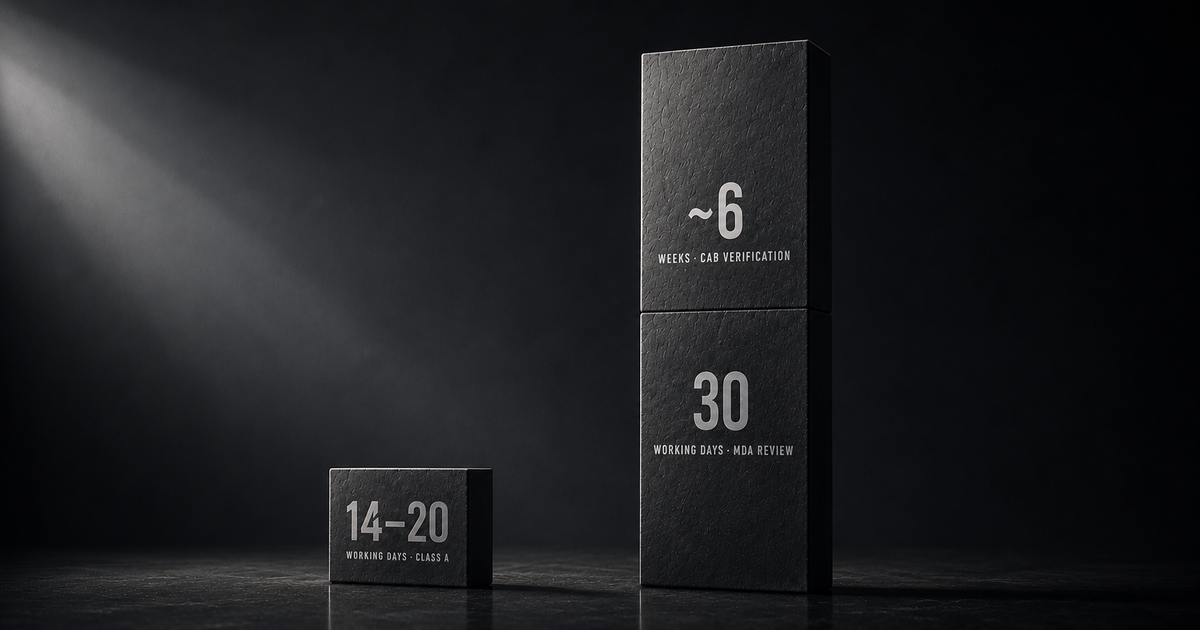
Class A devices do not require conformity assessment by a Conformity Assessment Body (CAB). They go directly to MDA. The published review timeline is 14 to 20 working days.
Classes B, C and D all require conformity assessment by a CAB before MDA ever opens the file. MDA’s published review KPI for those classes is 30 working days, but that number is narrower than it looks. The clock starts only once MDA deems the submission complete, and completeness for B, C and D explicitly includes the CAB certificate and the conformity assessment report. Everything the CAB does happens before the 30 day clock exists.
| Parameter | Class A | Class B, C and D |
|---|---|---|
| CAB conformity assessment | Not required | Required before MDA submission |
| MDA review timeline | 14 to 20 working days | 30 working days |
| When the clock starts | On complete submission to MDA | On complete submission, including CAB certificate and report |
| Certificate validity | 5 years | 5 years |
A complete Class B, C or D submission means all of the following in hand: the classification and grouping declaration, the ASEAN CSDT including an updated clinical evaluation or performance report, labelling and risk analysis, manufacturer information with a current QMS certificate, evidence of pre market clearance from a recognised authority, the CAB certificate and conformity assessment report, updated post market surveillance and vigilance data, and a valid Declaration of Conformity. Anything missing and the file is not complete, which means the 30 working day KPI has not started.
Treat the MDA KPI and the CAB lead time as two separate numbers. They are not one blended figure, and any single elapsed time number you see quoted for Malaysian device registration deserves scrutiny about what it actually includes.
What is the conformity assessment pathway, and which route applies?
For Classes B, C and D there are two routes through a CAB, and which one applies is worth establishing early because it is the largest single variable in your pre MDA runway.
Full assessment applies where the device carries no prior approval from a recognised foreign regulator. The CAB conducts a complete technical review. MDA has not published a fixed duration for full assessment, so treat it as materially longer than verification and scope it with your chosen CAB directly rather than planning against an assumed figure.
Verification, the abridged route, applies where the device already holds pre market approval from a recognised regulator. The CAB verifies against that existing approval instead of reassessing from the ground up. Verification route assessment runs approximately one and a half months from engagement through to certificate issuance. The route is governed by MDA/GD/0068, Guide for CABs on Conducting Conformity Assessment by Way of Verification, 2nd Edition, published 8 September 2025, and by Circular Letter 2/2025, effective 30 September 2025.
The recognised regulator list under the current circular is: EU Notified Bodies for CE certificates under MDR, MDD, IVDR or IVDD, Japan MHLW, Australia TGA, Health Canada, US FDA under 510(k) or PMA, UK MHRA, Singapore HSA, and Thailand FDA. Singapore HSA and Thailand FDA were added by Circular Letter 2/2025, which superseded Circular Letter 1/2025 of 11 March 2025, which in turn replaced Circular Letter 2/2014. The same 2025 update removed the previous one year marketing history requirement.
One exclusion catches manufacturers out. An approval granted only under an emergency or temporary access scheme does not open the verification route. That covers Emergency Use Authorisation, Special Access Programme, Special Access Scheme, and Singapore’s Special Access Routes. A device whose only clearance sits in one of those categories must go through full CAB assessment. If your Malaysian entry case rests on a pandemic era authorisation, check this before it becomes a scheduling problem.
What does registration actually cost, by class?
Fees are the least ambiguous part of the framework and the part most often misquoted in secondary summaries. The current MDA fee structure is:
| Class | Application fee (RM) | Registration fee (RM) |
|---|---|---|
| A | 500 | 750 |
| B | 250 | 1,000 |
| C | 500 | 2,000 |
| D | 750 | 3,000 |
| Combination, contains a medicinal product | 750 | 5,000 |
Note the point that trips people up. Class A is not fee exempt. It carries a registration fee obligation like every other class, and its application fee is higher than Class B’s. Several secondary summaries in circulation understate the Class A figures and omit the application fee for combination devices entirely. Check any fee number against the current MDA fee structure before you budget against it.
Post registration change notifications are charged separately, and are split between significant and non significant changes. Class A: RM 50 significant, RM 30 non significant. Class B: RM 500 and RM 30. Class C: RM 1,000 and RM 30. Class D: RM 1,500 and RM 30. Combination devices: RM 2,500 and RM 30. The non significant fee is a flat RM 30 across all classes.
Registration certificates are valid for five years from date of issuance, all classes.
These are government fees only. CAB fees, GDPMD certification for your Local Authorised Representative, and dossier preparation sit outside this table and will exceed it comfortably.
What happens if MDA asks for more information mid review?
This is the section that corrects the most common misconception a manufacturer carries into a Malaysian filing. The response window is not inside the 30 working day KPI. It sits outside it.
If MDA requests further information during review, two different windows apply depending on what is being asked for. Mandatory information or documents carry a 30 working day response window. Additional information, documents or samples carry a 90 working day window. Failure to respond within the applicable window results in rejection or deemed withdrawal of the application, not an extension.
MDA does not use the clock stop language that Singapore’s HSA uses, but the mechanism works the same way in practice. Your review clock pauses on you, and the time your team takes to assemble a response is time added to total elapsed duration. The same principle applies at CAB stage: a CAB’s stated turnaround explicitly excludes the establishment’s own response time.
The planning implication is straightforward. A 30 working day KPI plus a 30 working day response window plus MDA’s resumed review is a very different calendar from 30 working days, and the difference is largely inside your control. Query response readiness, meaning a nominated technical owner and source documents already assembled, is worth more to your launch date than anything else you can do after submission.
There is also a flat rule against a common shortcut. A single non responsive window closes the file. Do not treat an MDA query as something to park while a global team debates the answer.
What if you disagree with a CAB’s classification call?
There are two mechanisms and they are not interchangeable. Choosing the wrong one costs time.
The first is the Enhanced Process for Managing Classification Risk Disputes Between Establishment and CAB, effective 26 May 2025, made under Section 3(2) of Act 737. It exists specifically for a dispute between an establishment and a CAB over risk classification. The procedure is to complete the Dispute Classification Risk Form and submit it by email to MDA, to registration@mda.gov.my for general devices or ivd.registration@mda.gov.my for IVDs. MDA has not published a fee or a decision timeline for this route, which is itself a planning consideration.
The second is the new application route under MDA/GL/06, Guideline on How to Apply for Product Classification Application, 5th Edition, November 2025. This is a general classification determination request rather than a CAB dispute mechanism. Submission is via a Google Form on the MDA portal, the fee is RM 300, and MDA issues an invoice within three to five working days of submission. The 30 working day evaluation period begins once payment clears, not from the date of submission. If the application is returned for further information, the timeline resets on resubmission.
| Parameter | Enhanced Process | MDA/GL/06 new application |
|---|---|---|
| Purpose | Establishment versus CAB classification dispute | General classification determination |
| Basis | MDA announcement, effective 26 May 2025, Act 737 Section 3(2) | MDA/GL/06, 5th Edition, November 2025 |
| Submission | Dispute Classification Risk Form, by email | Google Form on the MDA portal |
| Fee | Not published | RM 300 |
| Timeline | Not published | 30 working days from payment clearance, resets if returned |
Neither Act 737 Section 3(2) nor GL/06 states that MDA’s classification decision is final. If you see that claim in a secondary summary, treat it as unsourced.
What should a manufacturer with a borderline device actually do?
Resolve the classification formally before you submit, not after MDA raises it.
Run the arithmetic on a device sitting on the A to B boundary. Confirmed Class A, direct to MDA, no CAB: three to four weeks is realistic for a complete submission. Reclassified to Class B: add a CAB verification cycle of roughly six weeks, which happens before the 30 working day MDA clock starts, and that is the good version, the one where the device qualifies for verification. Realistic total moves to something closer to three to four months. If the device does not qualify for verification and needs full CAB assessment, extend further, and MDA has published no benchmark to plan against.
The asymmetry is what matters commercially. The cost of resolving a contestable classification up front is RM 300 and a defined evaluation window under GL/06. The cost of getting it wrong is discovering at MDA review that your Class A self declaration does not hold, then routing through a CAB from a standing start, with a launch date already communicated internally. Class A has no CAB gatekeeper, which is exactly why a Class A misclassification only surfaces at MDA and only after you have spent the calendar.
Three practical calls follow. Where the class is genuinely contestable, and particularly where a device sits near the A to B line or has a marginal invasiveness or contact duration profile, use the formal determination route rather than defaulting to the lower class. Where the device is clearly B, C or D, engage a CAB and establish the route question early, because verification versus full assessment is a larger variable than anything downstream. And in either case, build the query response capability before you file, because the response windows sit outside the KPI and they are where most of the recoverable time is lost.
Classification is a pre submission risk decision with a price tag attached. Treat it as one.
Frequently Asked Questions
How are medical devices classified in Malaysia?
Into four risk classes, A through D, under a rule based system set out in MDA/GD/0009, Rules of Classification for General Medical Devices, 2nd Edition, 9 May 2022. The rules cover non invasive, invasive and active devices plus special rules, and are applied to the manufacturer’s stated intended use. IVD devices are classified under a separate parallel rule set driven by intended use and the consequence of a false result.
Which classes require a Conformity Assessment Body in Malaysia?
Classes B, C and D require conformity assessment by a CAB before submission to MDA. Class A does not and is submitted directly to MDA.
How long does MDA device registration take?
MDA’s published review timeline is 14 to 20 working days for Class A and 30 working days for Classes B, C and D. The clock starts only once MDA deems the submission complete, which for B, C and D includes the CAB certificate and conformity assessment report. CAB assessment time sits before that clock and is additional.
What is the MDA verification route and who qualifies?
Verification is an abridged conformity assessment for devices already approved by a recognised regulator: EU Notified Bodies, Japan MHLW, Australia TGA, Health Canada, US FDA, UK MHRA, Singapore HSA and Thailand FDA. Singapore HSA and Thailand FDA were added by Circular Letter 2/2025, effective 30 September 2025. Devices approved only under emergency or special access schemes are excluded and require full assessment.
What does it cost to register a medical device in Malaysia?
Application and registration fees are RM 500 and RM 750 for Class A, RM 250 and RM 1,000 for Class B, RM 500 and RM 2,000 for Class C, RM 750 and RM 3,000 for Class D, and RM 750 and RM 5,000 for a device containing a medicinal product. Class A is not fee exempt.
What happens if MDA requests more information during review?
A 30 working day response window applies to mandatory information and documents, and a 90 working day window to additional information, documents or samples. Failure to respond within the window results in rejection or deemed withdrawal. This response period sits outside the 30 working day review KPI, not inside it.
Can you dispute a device classification in Malaysia?
Yes, through two separate mechanisms. The Enhanced Process, effective 26 May 2025, handles disputes between an establishment and a CAB by email submission of the Dispute Classification Risk Form, with no published fee or timeline. The MDA/GL/06 new application route handles general classification determination via a portal form, costs RM 300, and runs 30 working days from payment clearance.
Sitting on a borderline classification, or unsure whether your existing approval opens the verification route? Talk to us before you file. Getting the class question settled up front is the cheapest month you will ever buy in Malaysia.