
NPRA Variation and Post-Approval Change: What Happens to Your MAL After Registration
C. Y. Chin, Business Development Director | Infinity Pharmacare | July 2026
A registered product’s MAL is not a fixed asset. Every material change to it, whether to manufacturing site, labelling, or the entity holding the registration, must run through NPRA’s variation framework, and implementing certain changes before approval puts the MAL itself at risk of suspension or cancellation. Which category a change falls into decides whether you may act first and notify later, or must wait for approval before you touch anything. Requirements in this briefing are drawn from primary NPRA sources including the Drug Registration Guidance Document (DRGD), Third Edition, 12th Revision, July 2026, and the Malaysian Variation Guideline for Pharmaceutical Products (MVG), 2nd Edition, July 2022; verify against current official guidance before relying on them.
Registration is where your obligations in Malaysia begin, not where they end. Once the National Pharmaceutical Regulatory Agency (NPRA) issues a MAL number, that registration becomes a living record that must match your product exactly. Any material change to the product, its manufacturing, its labelling, or its holder must be filed as a variation. Some of those changes may be made only after NPRA has approved them. Implementing them without approval puts the registration itself at risk of suspension or cancellation. For foreign manufacturers, this is the part of market entry most often underestimated, because it sits with the local Product Registration Holder (PRH) long after launch, quietly, for the entire life of the product.
The governing reference is the Drug Registration Guidance Document (DRGD), Third Edition, 12th Revision, July 2026, effective 31 July 2026, at Section E, Clause 20. The operative detail for pharmaceutical variations sits in the Malaysian Variation Guideline for Pharmaceutical Products (MVG), 2nd Edition, July 2022, which the DRGD incorporates by reference. This article sets out how that framework works, and where the commercial risk actually lives.
What is a variation, and why does it decide the fate of your MAL?
A variation is a change to the particulars of a registered product. NPRA sorts variations into three types by how far the change reaches into quality, safety and efficacy, and each type carries a different rule on whether you may implement before or after approval.
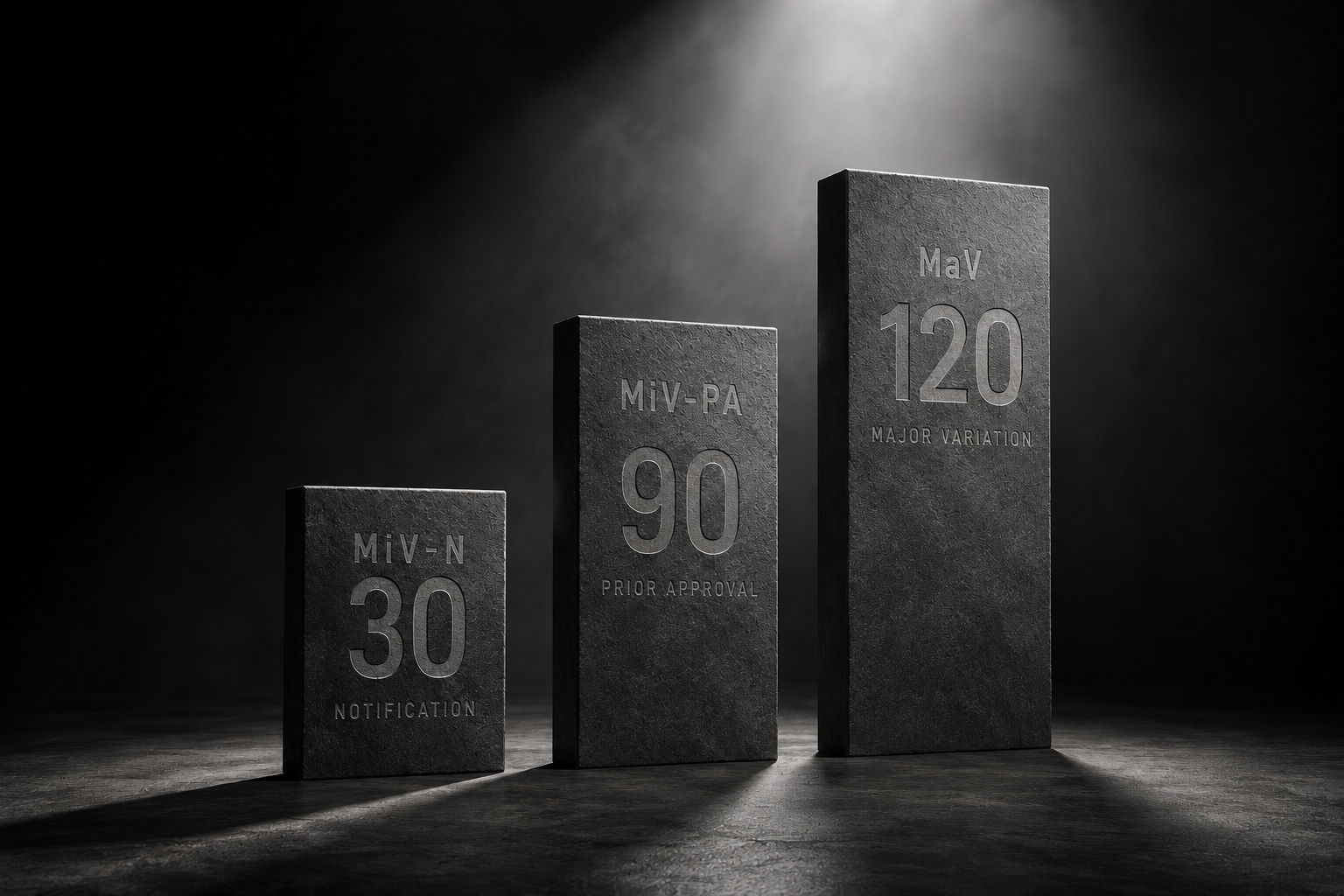
The three categories are Major Variation (MaV), Minor Variation Prior Approval (MiV-PA), and Minor Variation Notification (MiV-N). Biological products follow the same logic under the parallel labels MaVB, MiVB-PA and MiVB-N. The DRGD states the controlling principle plainly at Clause 20.1: no change of any particulars of a registered product, except for a Minor Variation Notification, shall be made without prior approval from NPRA.
That single sentence is why the category matters. It sets the default to wait for approval and carves out only one exception. Get the category right and you know exactly what you are allowed to do and when. Get it wrong, implement early, and you have exposed the registration to enforcement, which is the outcome the rest of this article is written to help you avoid.
Which changes fall into which category?
The category is driven by the magnitude of the change, and the MVG assigns each change type a specific item code. A senior regulatory reader will want the codes, so here are the common ones, mapped to the category NPRA places them in.
Major Variations cover changes that can move quality, safety or efficacy in a meaningful way. A change of the drug product manufacturing site is MaV-5. An extension of the product shelf life is MaV-16. A qualitative or quantitative change of excipient, where the change is significant, is MaV-11.
Minor Variations with Prior Approval cover changes with limited impact that still need NPRA to sign off before implementation. A change of drug product name is MiV-PA1. A change to the Patient Information Leaflet is MiV-PA3. A reduction of shelf life is MiV-PA35. A qualitative or quantitative excipient change at the minor level is MiV-PA16.
The excipient case is worth pausing on, because it is the one that catches people. The same change type, a qualitative or quantitative excipient change, sits in two different categories depending on scale: MaV-11 when the change is major, MiV-PA16 when it is minor. Do not assume a single code covers it. The magnitude decides.
Minor Variation Notifications cover low-impact administrative changes. Administrative or editorial changes to drug product labelling, for instance, are MiV-N19, and may be implemented and then notified rather than held for approval.
Separately, a New or Additional Indication is not processed as an ordinary variation. It runs through its own evaluation route under DRGD Clause 20.4 and requires clinical documentation to support the new claim.
How does a change of Product Registration Holder actually work?
This is the question foreign manufacturers ask most, usually when they are moving a product from one local partner to another, and the answer is that it is two steps, not one.
Transferring a registration to a different legal entity is handled as a Change of Product Registration Holder (COH) application under DRGD Clause 20.3 and Appendix 31. That application must be approved by NPRA first. Only after the transfer is approved does the incoming holder file MiV-N1 to update the product particulars, principally the labelling, to reflect the new holder. The MVG is explicit that MiV-N1 applies after the transfer procedure has been approved, and that the formal transfer application must come first.
A change to the name or address of the same existing holder, where no new legal entity is involved, is the simpler case and is handled directly as MiV-N1.
The distinction has real commercial weight. If you are a foreign manufacturer changing your Malaysian partner, the transfer is a COH application with its own approval step, and the label update follows it. Treating the whole thing as a single notification, as some summaries do, understates what is involved and the time it takes.
How long does each variation take, and what are you accountable for?
There are two separate clocks here, and conflating them is the most common error in circulation. One clock runs against you as the applicant. The other runs against NPRA.
| Category | Applicant reply deadline | NPRA processing timeline |
|---|---|---|
| Minor Variation Notification (MiV-N) | Not applicable, Do and Tell basis | 30 working days |
| Minor Variation Prior Approval (MiV-PA) | 45 working days | 90 working days |
| Major Variation (MaV) | 60 working days | 120 working days |
| Grouped application | 60 working days | 150 working days |
| Other bundled application (above grouping band) | 60 working days | 180 working days |
Source: DRGD, Third Edition, 12th Revision, July 2026, Clause 20.1.5.
If you have seen older figures built around a first-correspondence and subsequent-correspondence structure, those come from the earlier MVG model and have been superseded. The current DRGD uses one total figure per category, not a series of correspondence rounds.
Reliance shortens the NPRA clock where the same change has already been approved by a reference authority. Under DRGD Clause 20.1.3, a variation approved by at least one of NPRA’s reference countries may be submitted through the reliance pathway, with the following processing targets.
| Reliance submission type | NPRA processing timeline |
|---|---|
| Excluding any Major Variation | Not more than 80 working days |
| Including Major Variation, up to 10 categories | Not more than 100 working days |
| Including Major Variation, more than 10 categories | Not more than 150 working days |
Source: DRGD, Third Edition, 12th Revision, July 2026, Clause 20.1.3.
For a manufacturer already holding a stringent-authority approval for the change, reliance is the faster route and should be the default consideration.
When can you implement a change, and when must you wait?
The implementation rule follows directly from the category.
Major Variations and standard Minor Variations with Prior Approval may be implemented only after NPRA approves them, and the MVG allows a window of six months from the date of approval to put the change into effect. You approve first, then implement.
Minor Variation Notifications work the other way, on a Do and Tell basis. The change is implemented and then notified to NPRA, which reviews the notification within 30 working days. A notification is not a rubber stamp: NPRA can still reject it, and if it does, the holder must stop using the change and recall affected batches under Good Distribution Practice.
There is one expedited route inside the Prior Approval band worth knowing. Certain safety-related changes qualify as Tell and Do and may be implemented immediately on submission, without waiting for the full approval cycle. This is a narrow, listed set of changes, not a general shortcut, and it is distinct from the MiV-N notification route.
What does a variation cost?
The published variation fees are set out below.
| Variation type | Fee (RM) |
|---|---|
| Minor Variation Prior Approval (MiV-PA), full evaluation | 150 |
| Major Variation (MaV), full evaluation | 300 |
| Additional Indication | 1,000 |
| Change of Manufacturing Site | 1,000 |
| Change of Product Registration Holder | 1,000 |
| Minor Variation Notification (MiV-N) | Not listed in the fee schedule |
Source: DRGD Appendix 9, 11th Revision, January 2026. Not yet confirmed against the 12th Revision fee appendix.
No fee line is listed for a Minor Variation Notification in the variation fee schedule. That is worth reading precisely: the schedule does not list a MiV-N fee, which is not the same as a confirmed fee exemption. Treat the fees themselves as the headline cost, not the whole cost. The larger commercial figure in any variation is the preparation, the dossier work and the timeline, not the filing fee.
What happens if you implement a change without filing it?
This is where the framework has teeth. The DRGD states at Clause 20.1(e) that the registration of a product shall be reviewed for suspension or cancellation if changes falling under Major Variation or Minor Variation Prior Approval are implemented without prior approval of the Authority. The DRGD is issued under the Control of Drugs and Cosmetics Regulations 1984, so this is not guidance you can treat as optional.
The exposure is the registration itself, not merely the batch. An unauthorised MaV or MiV-PA can cost you the MAL, which is a different and larger risk than a product recall. And for a Minor Variation Notification that NPRA ultimately rejects, the holder must cease applying the change and recall affected batches. For a foreign manufacturer whose Malaysian market access rests entirely on that single registration, this is the risk that justifies active lifecycle management rather than a file-and-forget approach.
How is a variation different from a renewal?
They are separate obligations, and one does not cover the other. A MAL registration is valid for five years. Renewal, or re-registration, is a distinct application submitted within six months before expiry, and it re-confirms the registration for a further cycle. Variation, by contrast, is event-driven: it is triggered whenever a specific particular of the product changes during the currency of the registration.
The practical consequence is that a single five-year registration can require several variations along the way, and none of them resets or substitutes for the renewal. Approving a variation does not renew your MAL, and renewing your MAL does not retroactively capture changes you failed to file as variations. The two must be tracked independently.
Can you bundle changes together?
Yes, within limits. NPRA permits grouping, where a holder combines related changes into a single application. A grouped or bundled application may contain up to five variation categories, including a maximum of three Major Variations. Grouping consequential changes into one submission is often more efficient than filing them separately, provided they genuinely belong together, and the processing timeline for the group follows the higher band, as set out above.
What this means for a foreign manufacturer
Registration gets you into the Malaysian market. Variation management keeps you there. Every change to your product over its life, from a new manufacturing site to a change of local partner, runs through this framework, and the obligations sit with the PRH holding your MAL. That is the reason the choice of registration holder is a lifecycle decision, not an administrative one. Implement a Major Variation or a Minor Variation Prior Approval before NPRA signs off, and what you put at risk is not a batch. It is the MAL itself.
Frequently Asked Questions
What is a variation under Malaysia’s drug registration framework?
A variation is a change to the particulars of a registered product, sorted by NPRA into three types by how far the change reaches into quality, safety and efficacy. The default rule under DRGD Clause 20.1 is that no change may be made without prior NPRA approval, except for a Minor Variation Notification.
What are the three variation categories, and how do they differ?
Major Variation (MaV), Minor Variation Prior Approval (MiV-PA), and Minor Variation Notification (MiV-N), with the parallel biological labels MaVB, MiVB-PA and MiVB-N. MaV and MiV-PA require NPRA approval before implementation. MiV-N operates on a Do and Tell basis, implemented first and then notified.
How long does NPRA take to process a variation?
NPRA processes a Minor Variation Notification within 30 working days, a Minor Variation Prior Approval within 90 working days, a Major Variation within 120 working days, a grouped application within 150 working days, and other bundled applications within 180 working days. These are single total figures under the current DRGD, not a series of correspondence rounds as under the earlier MVG model.
How does a change of Product Registration Holder actually work?
It is two steps, not one. Transferring a registration to a different legal entity requires a Change of Product Registration Holder (COH) application under DRGD Clause 20.3 and Appendix 31, approved by NPRA first. Only after that approval does the incoming holder file MiV-N1 to update the product particulars.
What does a variation cost?
Published fees under DRGD Appendix 9, 11th Revision, are RM 150 for a Minor Variation Prior Approval, RM 300 for a Major Variation, and RM 1,000 each for an Additional Indication, a Change of Manufacturing Site, or a Change of Product Registration Holder. No fee line is listed for a Minor Variation Notification.
What happens if you implement a variation without NPRA approval?
Under DRGD Clause 20.1(e), the registration itself shall be reviewed for suspension or cancellation if a Major Variation or Minor Variation Prior Approval is implemented without prior NPRA approval. The exposure is the MAL, not merely the affected batch.
Managing a variation on a product you already have registered, or planning a change of local partner? Get the category right before you file. A misclassified variation costs you time. An unauthorised one costs you the MAL.