
What Is a Product Registration Holder (PRH) in Malaysia and Why You Cannot Hold Your Own MAL
A foreign manufacturer cannot hold its own Malaysian marketing authorisation. It must appoint a locally incorporated Product Registration Holder. If that PRH is your distributor, the MAL is legally theirs, and getting it back later requires their board’s unanimous signed consent, with NPRA declining to mediate. The PRH structure is therefore a commercial decision, not an administrative one. This briefing is drawn from primary NPRA sources, including the Drug Registration Guidance Document (DRGD), 3rd Edition, 11th Revision, January 2026, and the Control of Drugs and Cosmetics Regulations 1984; verify against current official guidance before relying on it.
Most foreign manufacturers treat the local registration holder as a box to tick. They sign whoever imports the product and move on. That is the mistake. In Malaysia the entity that holds the registration owns the market access, not the manufacturer that owns the molecule. Understanding what the PRH is, who owns the registration, and what it takes to move it later is the difference between controlling your Malaysian franchise and renting it from a partner who can lock you in.
What is a Product Registration Holder (PRH) in Malaysia?
A Product Registration Holder is the locally incorporated company that holds the marketing authorisation for a registered pharmaceutical product in Malaysia and carries full regulatory accountability for it. In Malaysia the PRH and the MAL holder are the same entity. The MAL number issued on registration belongs to the PRH.
The DRGD (3rd Edition, 11th Revision, January 2026) states it plainly: “The applicant for product registration, known as the Product Registration Holder (PRH), must be a locally incorporated company, corporate or legal entity, with permanent address and registered with the Companies Commission of Malaysia (SSM) (with business scope related to health/ pharmaceutical product).”
That definition rules out three parties manufacturers routinely confuse with the PRH. The manufacturer makes the product and must appear on the label, but does not hold the MAL. The product owner owns the formulation and the intellectual property behind it, and is often the foreign manufacturer itself, yet the product owner does not hold the marketing right either. The licensed importer holds an import licence to bring the registered product into the country, which is a logistics permission, not the registration. Only the PRH holds the MAL.
| Party | What it controls | Must be Malaysian | Holds the MAL |
|---|---|---|---|
| Product Registration Holder (PRH) | The marketing authorisation and all regulatory obligations for the product | Yes, SSM-incorporated | Yes |
| Manufacturer | Manufacture of the product; named on the label | No | No |
| Product owner | The formulation and the intellectual property | No | No |
| Licensed importer | Import of the registered product under an import licence | Yes, locally licensed | No |
In Malaysia the marketing authorisation and the registration certificate are the same thing. Both are identified by the MAL number, and both sit with the PRH.
Can a foreign manufacturer hold its own MAL in Malaysia?
No. There is no pathway under Malaysian law for a foreign entity to hold a Malaysian MAL in its own name. The National Pharmaceutical Regulatory Agency (NPRA), Malaysia’s drug regulator under the Ministry of Health, is explicit in its Product Registration FAQ (last updated 6 May 2026): “A foreign company wishing to bring pharmaceutical products into Malaysia would first have to appoint a local agent (a company registered in Malaysia) to be the holder of the registration certificate. The appointed agent would then be responsible for all matters pertaining to the registration of the products.”
Read that carefully, because the wording trips people up. The “holder of the registration certificate” and the “Product Registration Holder” are the same role, not two separate parties. The local agent NPRA refers to is the PRH. There is one local entity that holds the registration, and it carries the regulatory responsibility that comes with it.
The prohibition that forces this structure sits in Regulation 7(1) of the Control of Drugs and Cosmetics Regulations 1984 (CDCR 1984), which bars any person from manufacturing, selling, supplying, importing, or possessing a product unless it is a registered product and that person holds the appropriate licence. Nothing legally moves in the Malaysian market until a registration exists, and a registration cannot exist without a local holder.
The rest of the system is built around that rule. Regulation 8 governs the registration application. Regulation 12 governs the manufacturer, import, and wholesaler licences. Regulation 28 governs notification of adverse reactions. Regulation 29 empowers the Director of Pharmaceutical Services to issue guidelines, including the DRGD itself. The practical point is the same across all of them: the holder of the registration must be a local entity, and that entity answers to NPRA for the product.
This also gates every registration pathway. Whether you file through full evaluation or an expedited route such as the Facilitated Registration Pathway, none of it begins until a PRH is nominated to submit on your behalf.
Who legally owns the registration, you or your PRH?
Your PRH owns the registration. You own the molecule. That split is the single most important thing to understand before you appoint anyone.
The MAL is issued in the PRH’s name and is the legal property of the PRH. The product owner, usually the foreign manufacturer, retains the formulation and the intellectual property behind the product. Those are two different assets. Owning the IP does not give you the marketing right in Malaysia. The marketing right is the MAL, and the MAL sits with the PRH.
The commercial consequence is direct. If your distributor is also your PRH, your distributor holds the legal key to your market access. You can own the science completely and still be unable to sell a single unit in Malaysia without that partner, because the registration that authorises the sale is theirs, not yours. That is the exposure the next section turns on.
What happens if you want to change your PRH?
This is where the structure bites. Moving a registration from one PRH to another is done through NPRA’s Change of Product Registration Holder (COH) process, and that process is built entirely around the cooperation of the PRH you are trying to leave.
Four facts define it, all from NPRA’s Change of Product Registration Holder guidance. First, NPRA processes a COH within 45 working days of a complete application. Second, the application to transfer must be submitted by the existing PRH, not by you and not by the incoming partner. Third, it requires a board resolution from the existing PRH, signed by all of its directors or partners, consenting to the transfer. Fourth, NPRA corresponds only with the existing PRH throughout, not with the product owner or any third party, and it does not mediate disputes between a PRH and a product owner.
Put those together and the risk is obvious. If your distributor holds the MAL and the relationship sours, you cannot move your product to a new partner unless that distributor’s board unanimously signs a resolution releasing it. One director who refuses, or a board that simply stalls, is enough to freeze the transfer. If they refuse outright, NPRA will not step in on your behalf, because it treats this as a commercial matter between you and your PRH, not a regulatory one.
There is no back door. No official mechanism in the COH process grants a manufacturer the right to reclaim a MAL without the existing PRH’s participation. The 45-working-day clock only starts once a complete application has been submitted, and only the existing PRH can submit it. Where a manufacturer has built in no protection in advance, a non-cooperative PRH can hold the registration, and therefore your Malaysian market access, for as long as it chooses. This is not a regulatory gap you can appeal your way around. It is a consequence of who the system makes accountable.
The protection, if you want it, is contractual, and it has to exist before you appoint. That is a matter for Malaysian counsel, not for NPRA.
What is a PRH actually responsible for?
The reason NPRA insists on a local holder is accountability. The PRH does not just hold a certificate. It carries the legal obligations for the product across its entire registered life, on the manufacturer’s behalf.
Pharmacovigilance sits with the PRH. It must run an adverse drug reaction monitoring system and report safety signals to NPRA. Product recall also sits with the PRH, and the timelines are tiered by the severity of the defect, not flat. Under the NPRA Guideline on Good Distribution Practice (GDP), 3rd Edition, 2018, a Degree I recall, where the defect is a major risk or could cause death, runs on a 24-hour timeline; a Degree II recall, for a minor or substandard defect, runs on 72 hours; and a Degree III recall runs within 30 days or as otherwise specified. Treating recall as a single 72 hour obligation understates the most serious cases.
Quality defects carry their own clock. The PRH has 30 days to identify the cause of a confirmed quality defect and propose corrective action, per NPRA’s Post-Marketing Activities guidance. Labelling compliance is the PRH’s responsibility, as is every post-approval change to the registration. Variations are submitted by the PRH and processed on published timelines under the DRGD (3rd Edition, 11th Revision, January 2026): minor variations requiring prior approval (MiV-PA and MiVB-PA) run to 90 working days, and major variations (MaV and MaVB) run to 120 working days. Where the PRH also holds an import or wholesaler licence, it carries Good Distribution Practice compliance on top.
None of this liability transfers back to you. The PRH is the accountable party of record. That is precisely why the identity of the holder is a commercial decision and not a clerical one. Whoever holds the MAL carries real legal exposure for your product, and holds your market access while they do.
PRH for drugs versus LAR for devices: what is the difference?
If you sell both drugs and devices into Malaysia, do not assume one local partner structure covers both. They are separate regimes with separate regulators.
The PRH is the pharmaceutical role. It sits under NPRA and the CDCR 1984. The Local Authorised Representative (LAR) is the device role. It sits under the Medical Device Authority (MDA) and the Medical Device Act 2012. Different statutes, different regulators, different licences, different submission systems. A company can hold both, but they are held separately and answer to different agencies.
The distribution standards differ too. Pharmaceutical distribution is governed by the NPRA Guideline on Good Distribution Practice (GDP), 3rd Edition, 2018. Device distribution is governed by the MDA Good Distribution Practice for Medical Devices (GDPMD), MDA/RR No. 1, November 2015.
| Dimension | PRH (pharmaceuticals) | LAR (medical devices) |
|---|---|---|
| Regulator | NPRA | MDA |
| Governing law | CDCR 1984 | Medical Device Act 2012 |
| Local role | Product Registration Holder | Local Authorised Representative |
| Distribution standard | GDP (NPRA, 3rd Edition, 2018) | GDPMD (MDA/RR No. 1, November 2015) |
The device side of this structure, including the MDA Establishment Licence a LAR must hold, is the subject of our companion briefing. Read this piece for the drug side, that one for the device side.
How should a foreign manufacturer choose its PRH structure?
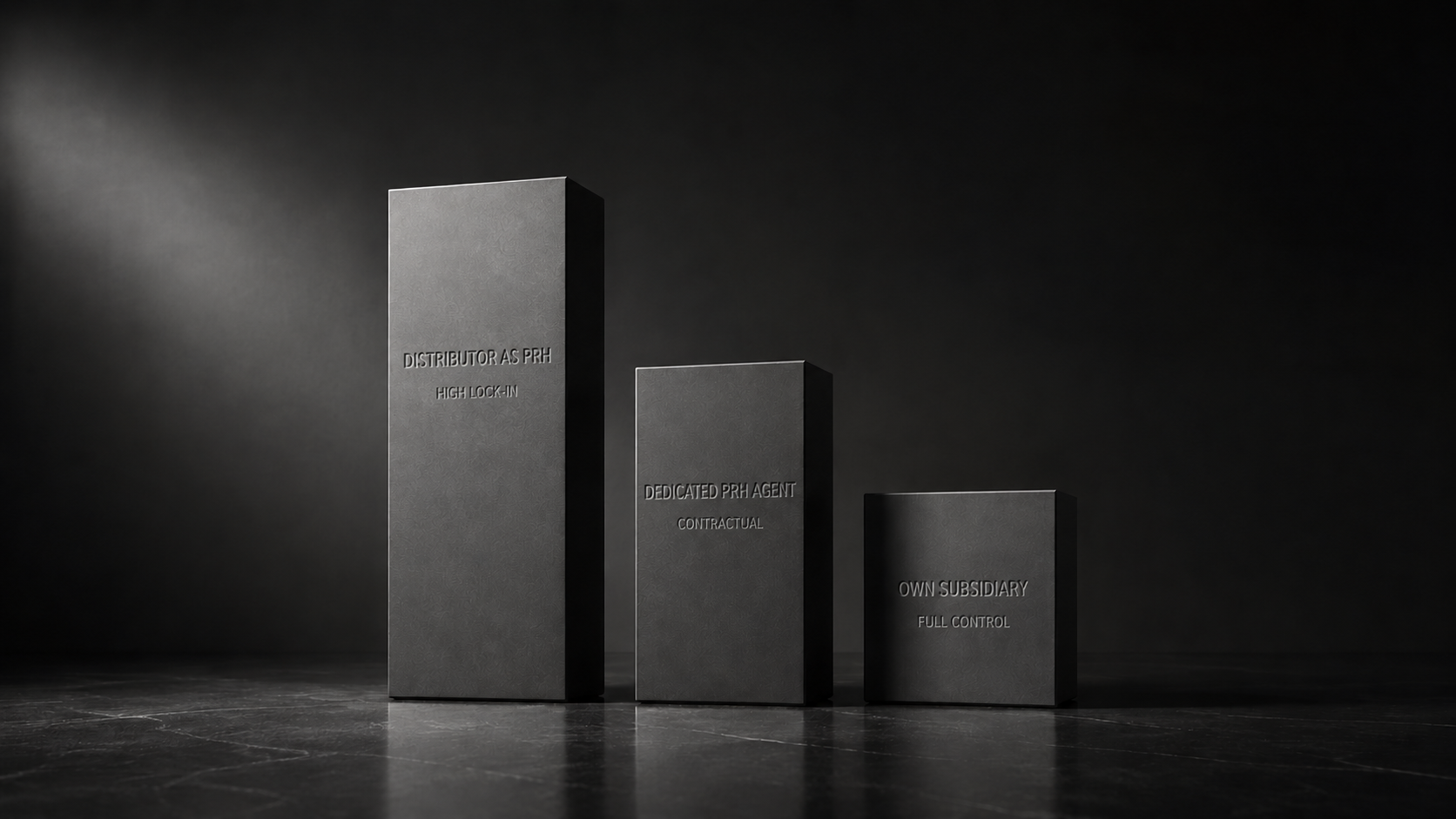
The choice comes down to how much control you are willing to trade for convenience, and it reduces to three structures. Compare them on the three things that actually matter later: control over the MAL, protection of your IP, and your ability to exit.
The first option is to appoint an independent distributor as your PRH. It is the fastest and cheapest way in, because your distributor already has the local entity and the licences. The cost is control. You hand the MAL to the same party that controls your sales, and the previous section is the result: low control, high lock-in, and a transfer that depends entirely on their board’s goodwill if you ever want to leave.
The second option is to appoint a dedicated PRH agent whose business is holding registrations, not distributing product. Your IP stays with you, the MAL is held on your behalf under a service arrangement, and because the agent does not sell your product, there is no distribution conflict that turns the registration into a bargaining chip in a commercial dispute. Control here is contractual rather than structural, which means the quality of the agreement carries the weight.
The third option is to incorporate your own local subsidiary and have it hold the MAL. This gives you the cleanest control, because you own both the holder and the registration outright. The trade is cost and time. You are standing up and running a Malaysian legal entity, with everything that entails, before you sell anything.
| Structure | Control over the MAL | IP protection | Exit and lock-in risk |
|---|---|---|---|
| Independent distributor as PRH | Low; held by your sales partner | IP stays with you; the marketing right does not | High; a transfer needs their board’s unanimous consent |
| Dedicated PRH agent | Contractual; no distribution conflict | IP stays with you | Moderate; governed by the service agreement |
| Wholly owned local subsidiary | Full; you own the holder | Full | Low; you control the entity and the MAL |
There is a reason the middle option exists. A dedicated PRH that holds your registration on your behalf, without also being your distributor, removes the specific lock-in described earlier: the conflict of interest that arises when the party selling your product is also the party that can refuse to release it. That is the structural position Infinity Pharmacare holds for the manufacturers it represents.
Frequently Asked Questions
Can a foreign company register a drug in its own name in Malaysia?
No. A foreign company cannot hold a Malaysian MAL directly. It must appoint a locally incorporated company, registered with SSM, to act as the Product Registration Holder and hold the registration on its behalf, per NPRA’s Product Registration FAQ and the DRGD.
Who owns the MAL, the manufacturer or the PRH?
The PRH owns the MAL. The manufacturer, as product owner, keeps the formulation and the intellectual property, but the marketing authorisation is issued in the PRH’s name and is the legal property of the PRH.
How long does it take to change a PRH in Malaysia?
NPRA processes a Change of Product Registration Holder within 45 working days of a complete application. The clock only starts once a complete application is submitted, and only the existing PRH can submit it.
Can I move my product to a new partner if my current PRH refuses?
Not without their cooperation. The transfer must be submitted by the existing PRH and requires a board resolution signed by all of its directors or partners. NPRA corresponds only with the existing PRH and will not mediate a dispute, so a non-cooperative holder can block the move. Any protection has to be agreed contractually before you appoint.
What is the difference between a PRH and a LAR?
The PRH is the pharmaceutical registration holder under NPRA and the CDCR 1984. The LAR is the Local Authorised Representative for medical devices under the MDA and the Medical Device Act 2012. Separate regulators, separate laws, separate licences.
What is a PRH responsible for?
Pharmacovigilance and adverse drug reaction reporting, product recall, variation submissions, labelling compliance, and, where it also holds an import or wholesaler licence, Good Distribution Practice. The PRH carries these obligations on the manufacturer’s behalf for the registered life of the product.
Deciding who should hold your MAL in Malaysia? Talk to us about structuring a PRH arrangement that keeps the registration working for you, not against you, and does not hand control of your market access to your distributor.