
How Foreign Manufacturers Access Malaysia’s Public Sector Drug Market: APPL, Central Contract, and Local Purchase
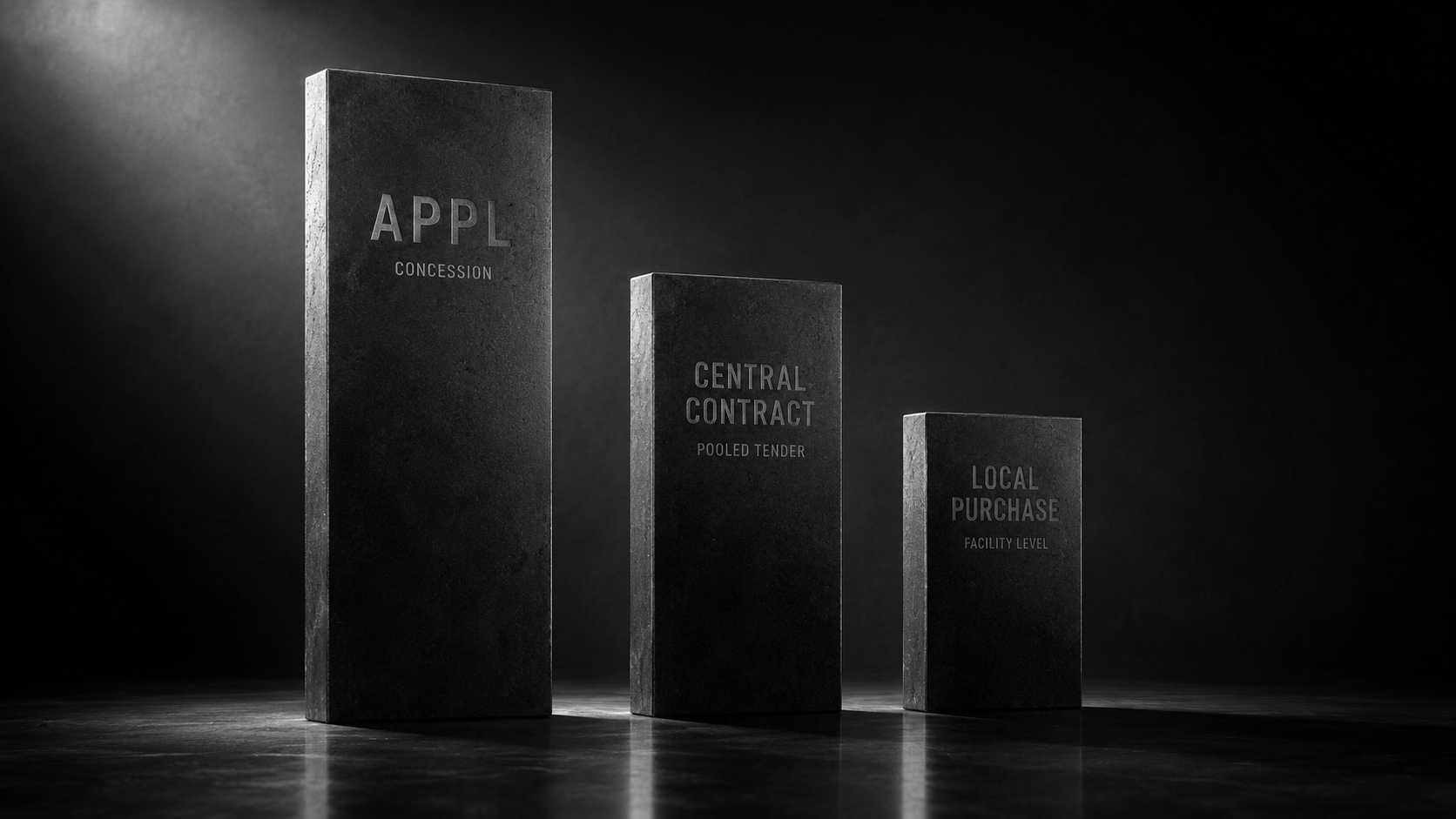
A foreign manufacturer reaches Malaysia’s public sector drug market through three channels, and the first real decision is which one leads. The Approved Product Purchase List (APPL), procured under a Pharmaniaga concession that runs to 30 June 2030, offers the highest price certainty and the widest reach across Ministry of Health (MOH) facilities. The Central Contract route carries the higher value specialty products and non APPL generics through competitive pooled tenders. Local Purchase fills the gaps at facility level, with the least certainty and the highest prices. All three sit behind one gate: a product must be listed in the MOH Medicines Formulary, held by a locally incorporated entity, before any government facility can buy it.
The public sector is the buyer that matters here. On a financing basis the private sector looks larger, but the MOH is by far the single largest institutional purchaser, the channel through which a foreign manufacturer actually negotiates. The price stakes are structural rather than about picking the cheapest route. As Section 7 sets out, stability of placement, not channel choice, determines a manufacturer’s price risk, and the public sector pays two to three times international reference prices regardless of method. The commercial task is to secure durable placement in the channel that fits the product, and to avoid being forced out of it.
What are the three channels, at a glance?
Channel 1, the APPL (Approved Product Purchase List): The APPL is Malaysia’s largest single-channel public drug supply mechanism. Company commentary and analyst reporting place the annual value of APPL procurement at an estimated RM 2.0 to 2.2 billion across 2025 to 2026, though this is not confirmed against a published Budget line item. Pharmaniaga Logistics Sdn Bhd holds a seven-year concession (effective 1 July 2023 – 30 June 2030) to procure, store, supply, and deliver APPL products to MOH facilities. Under the concession model, MOH negotiates prices directly with manufacturers or their local registered holders, and Pharmaniaga acts as the procurement and logistics concessionaire. Products on the APPL are procured at government-negotiated prices, giving manufacturers the highest price certainty and widest access to MOH facilities. The critical supply-side constraint is that products must first be listed in the MOH Medicines Formulary (MOHMF / Blue Book), and the manufacturer or its local Product Registration Holder (PRH) must engage proactively with BPF’s Formulary Management Subdivision on APPL inclusion.
Channel 2, the Central Contract (Kontrak Pusat / Pool Procurement): Central Contract procurement covers drugs not on the APPL that are high-value, high-volume items requiring inter-ministerial aggregation across MOH, MOHE university hospitals, and MINDEF’s military hospital. Tenders are issued by MOH’s Pharmaceutical Procurement Unit and published on ePerolehan. Bidders must be MOF-registered, GDP-licensed, and Malaysian-incorporated. A foreign manufacturer accesses this channel through a locally incorporated entity or licensed distributor holding the NPRA product registration and an MOF supplier registration in the relevant pharmaceutical field code. MOH has publicly reported meaningful savings from pool procurement versus segmented purchasing, though independent peer-reviewed analysis points to more modest median price reductions of around 5%. The channel carries more volume risk because contracts are awarded by competitive tender, typically for three-year periods.
Channel 3, Local Purchase / ePerolehan (Sebut Harga and Direct Tender): Individual government health facilities manage their own procurement for drugs not covered by APPL or Central Contract, subject to a RM 500,000 per-transaction ceiling. Quotations are solicited through ePerolehan from MOF-registered suppliers. This is the most accessible channel for a foreign manufacturer’s agent but yields the least price certainty and lowest volumes. Products moved from APPL to this channel in the contract gap period of H2 2023 saw price increases of up to 500%, and consistently 200–300% higher pricing, demonstrating both the pricing consequence of channel displacement and the market distortion that arises when supply structures are disrupted.
The single most important access decision a foreign manufacturer faces is whether to engage with the APPL route or the Central Contract route as the primary government channel. APPL placement offers price security and volume certainty for the duration of the concession (to 30 June 2030), but requires MOHMF listing and a strong relationship with Pharmaniaga as the concession-operating logistics entity. Central Contract is the higher-value channel for specialty and non-APPL generics, but requires sustained competitive tendering capability through a capable, GDP-licensed local partner.
How do the three channels compare?
| Attribute | Channel 1: APPL | Channel 2: Central Contract | Channel 3: Local Purchase / ePerolehan |
|---|---|---|---|
| What it procures | Several hundred essential & generic drugs (Pharmaniaga targets ~1,200) | Non-APPL, high-expenditure drugs; specialty & off-patent items pooled across MOH/MOHE/MINDEF | Any MOHMF-listed drug not covered by Channel 1 or 2; facility-specific needs |
| Who can sell | Manufacturer/PRH negotiates with MOH; Pharmaniaga sub-contracts supply and handles logistics | Any MOF-registered, GDP-licensed locally incorporated entity; open to local and effectively foreign (via local entity) | Any MOF-registered local supplier; open tender above RM 500K threshold |
| Local structure required | NPRA PRH (local company); MOHMF listing; relationship with Pharmaniaga concessionaire | Malaysian-incorporated entity; MOF registration; NPRA Import/Wholesaler Licence; GDP compliance | Malaysian Sdn. Bhd.; MOF registration; ePerolehan account; NPRA Import/Wholesaler Licence |
| How a product gets in | MOHMF listing → APPL nomination by MOH/BPF → price negotiation with manufacturer → Pharmaniaga issues supply sub-contracts | MOHMF listing → facility/clinical demand → BPF Logistic Subdivision issues tender → open or pool tender via ePerolehan | MOHMF listing → facility identifies need → Sebut Harga or tender ≤ RM 500K via ePerolehan |
| Pricing mechanism | Government-negotiated fixed price with manufacturer; APPL price set per concession cycle; USD FX protection reportedly embedded in 2024-cycle contracts (specific rate to be verified) | Competitive tender (open or pool); price index shows downward pressure over successive tender rounds; MOH reserves right to renegotiate | Market-driven quotation; most volatile; 200–500% higher than APPL for identical products when coverage lapses |
| Typical duration | Concession to 30 June 2030; product sub-contracts within concession issued periodically (recent batch to Dec 2026) | Three-year supply contracts standard; pool procurement cycles since 2020 | Ad hoc; quotation valid for period of contract; low volume per event |
| Access certainty for manufacturer | High (government-mandated channel with set allocation); RM 2.0–2.2B government allocation in 2025–2026 | Medium (competitive; award-dependent) | Low (facility discretion; small lots) |
Why is the public sector the buyer that matters?
Start with the money, because the financing split misleads. According to Malaysia’s National Health Accounts (MNHA) 2023 data published by MOH Planning Division in January 2025, total pharmaceutical expenditure (TPE) reached RM 16,921 million in 2023, representing 20.1% of total health expenditure. The public-private financing split in 2023 was 28.1% public (RM 4,751 million) vs. 71.9% private (RM 12,170 million). This marks a notable rebalancing: during COVID-19 in 2021 the public share spiked to 49.1% (vaccine procurement), returning to the 28–30% range post-pandemic. The CAGR of public pharmaceutical spending from 2018 to 2023 was 6.9% versus 9.0% for private.
Caveat: The MNHA data uses “financing source” (who paid), not “who purchased.” The private sector’s nominally larger share reflects high out-of-pocket and insurance spending at private hospitals and community pharmacies. In terms of centralised purchasing power, the channel through which a foreign manufacturer negotiates, the MOH alone accounted for approximately RM 4,470 million in 2023, making it by far the single largest institutional buyer. MOH pharmaceutical expenditure represents approximately 12.4% of total MOH spending (normalised; 20.2% in 2021 due to vaccine procurement).
For 2021 (most recent year with published channel-level data from MNHA and MOH Pharmaceutical Services Programme), MOH drug spending was approximately RM 2,552 million. Of this, 86% was procured through pooled procurement systems: approximately 44% (RM 1,111 million) through the concession (APPL), and 42% (RM 1,070 million) through centralized contracts (Central Contract / pool tender). The remaining ~14% was segmented or facility-level local purchase.
Caveat: This 2021 figure is dated. Channel values have shifted. Company commentary and analyst reporting place the APPL allocation at an estimated RM 2.0 billion in 2025 and RM 2.1 to 2.2 billion in 2026 as the product list expands under the new concession; these estimates are not confirmed against a published Budget line item. Central Contract values are not publicly reported by channel in recent annual reports.
Government pharmaceutical procurement in Malaysia spans several distinct buyer groups:
- MOH hospitals and health clinics: The dominant buyer, encompassing national, state and district hospitals and primary health clinics. MOH accounts for approximately 86% of total public sector pharmaceutical spending.
- University teaching hospitals (MOHE): Six MOHE university hospitals participate in pool procurement alongside MOH and MINDEF from 2020 onward. They have their own formularies but participate in joint Central Contract tenders.
- Military hospital (MINDEF): One MINDEF military hospital joins the inter-ministerial pool procurement arrangement.
- State Health Departments (Jabatan Kesihatan Negeri / JKN): State-level BPF units coordinate state-level ordering within the APPL and Central Contract frameworks.
- Other public institutions: Government prisons, immigration detention facilities, and statutory bodies with medical units may procure independently as MOF-registered buyers, typically through local purchase.
Channel 1: how does the APPL and the Pharmaniaga concession work?
The APPL is a government-designated list of pharmaceutical and non-pharmaceutical medical products that MOH procures through a dedicated concession arrangement. The APPL covers several hundred pharmaceutical products. Pharmaniaga management has publicly indicated a target to expand the list materially over the concession period, with figures around 1,200 products cited in company commentary and reporting. The APPL was created as part of the privatisation of government medical stores in 1994, originally assigning procurement, storage, and logistics functions to Pharmaniaga Berhad.
Pharmaniaga Logistics Sdn Bhd (PLSB), a wholly-owned subsidiary of Pharmaniaga Berhad, holds the concession pursuant to a seven-year Concession Agreement (CA) signed in January 2024, effective retrospectively from 1 July 2023 and running until 30 June 2030. Under the CA, Pharmaniaga is responsible for the procurement, storage, supply, and delivery of APPL medical products to MOH-operated offices and facilities. News reporting on Pharmaniaga’s earnings outlook places the annual APPL allocation at approximately RM 2 billion in 2025, rising to an expected RM 2.2 billion in 2026; these figures derive from analyst and company commentary rather than a published Budget line item.
Under the prior concession model (pre-2023), Pharmaniaga earned a fixed percentage markup over purchase prices for APPL drugs. The current concession structure involves similar logistics-remuneration principles, though exact margin terms are not publicly disclosed.
Caveat, key embedded price assumption: Contracts issued under the April 2024 APPL cycle are reported to incorporate an embedded USD/MYR exchange rate that provides a measure of FX protection for foreign manufacturers pricing in USD. The specific rate should be verified against the contract terms before relying on it in pricing models.
How does a drug get onto the APPL?
APPL listing follows a structured pathway governed by BPF:
- MOHMF (Blue Book) listing is a prerequisite. A drug must first be listed in the Ministry of Health Medicines Formulary (MOHMF), evaluated by BPF’s Formulary Management Subdivision using clinical efficacy, safety, and health technology assessment (HTA) criteria. Since February 2024, the third edition of the GP Dossier Submission Guideline (2024) applies. The PRH or an authorised local company submits a D1 dossier (new medicine listing, fee RM 5,000; new indication on an existing medicine, RM 3,000) or a D2 dossier (new dosage form or strength, fee RM 2,000). Fees are non-refundable and payable within 15 working days of screening approval. To list a New Chemical Entity (NCE), the guideline sets five eligibility criteria at Letter of Intent stage: the active moiety must not already be listed in the MOHMF; the NCE must have been DCA-registered for at least 12 months; it must have been in active local use for at least the most recent 6 months post-registration; the listed indication must be DCA-approved; the product must already appear on the reimbursement list or national formulary in at least two other countries; and it must demonstrate therapeutic or safety advantage supported by scientific evidence. Where a product meets only some criteria, BPF will consider a written justification case-by-case.
- MOHMF listing does not automatically confer APPL inclusion. BPF’s Logistic Pharmacy Management Subdivision manages the APPL product list separately and coordinates the addition of products to the concession schedule. MOH can choose which MOHMF-listed drugs are included in the APPL based on volume, pricing negotiations, and supply security considerations.
- Price negotiation between MOH and the manufacturer/PRH. MOH’s BPF directly negotiates prices with the manufacturer or its local PRH for products being added to the APPL. The concession holder (Pharmaniaga) then issues sub-contracts to the manufacturer’s local supply partner.
- Sub-contracts issued by Pharmaniaga. Once MOH approves APPL inclusion and price, Pharmaniaga issues letters of offer or supply sub-contracts to the identified suppliers. Duopharma Biotech, for example, received 11 letters of offer from Pharmaniaga for 86 products in April 2024.
The MOHMF is updated approximately two to three times per year. Dossier reviews can take 12–24 months; HTA is moving toward real-world evidence as of August 2025.
Can a foreign manufacturer’s registered product be added?
Yes. The NPRA does not require the product registration holder to be a domestic manufacturer; local incorporation as a private limited company (Sdn. Bhd.) is sufficient. A foreign principal can:
- Appoint a locally incorporated PRH (must be a Malaysian Sdn. Bhd.) who holds the NPRA product registration under the Control of Drugs and Cosmetics Regulations 1984.
- That local PRH, or a separately appointed GDP-licensed distributor, then interfaces with Pharmaniaga for APPL sub-contracting.
The earlier APPL model under the “Skim Anak Angkat (SAA)” scheme (dated, from a 2017–2019 MOH notice) required manufacturers wishing to supply via SAA to have a locally operating factory, effectively limiting that specific Bumiputera-partnership scheme to domestic manufacturers. This scheme is separate from the standard APPL product inclusion pathway available to registered products generally.
Caveat: It is not clear from available public sources whether an equivalent domestic-factory requirement applies to standard APPL listing in the 2023–2030 concession. This point should be verified with BPF’s Logistic Pharmacy Management Subdivision before planning.
How is the APPL price set?
Prices are set through direct negotiation between MOH’s BPF and the product manufacturer or PRH prior to APPL inclusion. The negotiated price is then fixed for the contract period. The 2024 APPL contract cycle is reported to have embedded a fixed USD/MYR rate, providing a form of FX protection for foreign-manufactured products priced in USD; the specific rate should be verified against the contract terms. MOH’s Medicine Price Management Subdivision maintains a price database and conducts international reference price comparisons. Under the Malaysian National Medicines Policy, MOH is developing a National Pricing Reference for Medicines and is committed to external reference pricing (ERP) using the average of the three lowest prices among reference countries as a ceiling price methodology.
Caveat: As of mid-2026, a formal ERP regime for public sector procurement has not been fully gazetted; the policy intent has been signalled since 2019.
Channel 2: how does the Central Contract (pool procurement) work?
Central Contract (also called pool procurement or pooled tender) covers pharmaceutical products that are listed in the MOHMF but not on the APPL, and of sufficient volume or expenditure to warrant centralised procurement across multiple government facilities.
BPF’s Logistic Pharmacy Management Subdivision coordinates this channel, issuing tenders for products pooled either within MOH facilities exclusively, or inter-ministerially across MOH, MOHE’s six university hospitals, and MINDEF’s military hospital. MOH has publicly stated that pool procurement across 82 drugs between 2020 and 2022 saved approximately RM 79.6 million (around 17.7%) versus segmented facility procurement. A peer-reviewed analysis of MOH procurement data is more conservative: across eight high-expenditure therapeutic subgroups (73 drugs), switching from segmented to pooled procurement produced a median price reduction of roughly 5%, with around 79% of pooled procurements showing a price decrease. The same study cautioned that pooled tendering does not consistently outperform segmented purchasing when benchmarked against international reference prices. The MOH Pharmaceutical Procurement Unit publishes tender results on the MOH website.
Who can bid?
Bidders for Central Contract tenders must be:
- Malaysian-incorporated entities registered with the Companies Commission of Malaysia (SSM), typically a Sdn. Bhd.
- MOF-registered suppliers with an active Sijil Kementerian Kewangan, registered under the relevant pharmaceutical field code (kod bidang) on ePerolehan. Suppliers must hold the correct pharmaceutical supply field code to receive tender invitations and submit bids; the specific code should be confirmed against the current ePerolehan field-code directory or a live pharmaceutical tender announcement at the point of registration.
- Holders of a valid NPRA Import Licence or Wholesaler’s Licence under Regulation 12(1) of the Control of Drugs and Cosmetics Regulations 1984.
- GDP-compliant with NPRA’s Good Distribution Practice guidelines (a longstanding mandatory licence condition under CDCR 1984).
A foreign manufacturer cannot directly bid. It must route through a locally incorporated, MOF-registered, NPRA-licensed entity. That entity may be the PRH (which holds the NPRA product registration), if it is also GDP-licensed and MOF-registered, or a separately appointed licensed distributor/wholesaler appointed in writing by the PRH.
How do Bumiputera status requirements affect a bid?
Malaysian government procurement generally applies Bumiputera preferences below certain value thresholds under Treasury Instructions (Arahan Perbendaharaan):
- RM 20,000 – RM 50,000: Quotations from any MOF-registered local company (no Bumiputera requirement).
- RM 50,000 – RM 100,000: Quotations only from Bumiputera companies registered with MOF.
- RM 100,000 – RM 500,000: Any MOF-registered company eligible, but Bumiputera companies receive a price preference.
- Above RM 500,000: Open tender; Bumiputera companies still receive price preference in evaluation but non-Bumiputera companies may bid.
The Bumiputera price preference applied during financial evaluation is set on a sliding scale under PK 2.1: 10% for procurements up to RM 10 million, 5% for RM 10 million to RM 100 million, and 3% above RM 100 million. For most pharmaceutical procurement values the 10% margin is the operative figure, meaning a non-Bumiputera local partner must price at least 10% below a Bumiputera competitor to be evaluated as competitive.
In practice, Central Contract tenders for pharmaceuticals almost always exceed RM 500,000. Open tender applies; Bumiputera companies receive evaluation preference but non-Bumiputera local companies and foreign-owned local entities can participate. The MOF field codes for pharmaceutical supply under ePerolehan are generally available to companies with full or partial foreign ownership; they are not restricted to Bumiputera entities as a hard-bar, though Bumiputera status confers competitive scoring advantage. The earlier Skim Anak Angkat and Skim Panel Pembuat Bumiputera (SPPB) schemes specifically reserved certain APPL supply slots for Bumiputera manufacturers; these apply to domestic manufacturing-based schemes, not standard tender participation by importers.
Where legal requirement and commercial practice diverge: while non-Bumiputera and partially foreign-owned entities can technically participate in open pharmaceutical tenders, the market practice is that many local agents and distributors are Bumiputera-majority owned to maximise scoring and goodwill with procurement boards. Appoint a partner accordingly.
Duration, evaluation, and how a foreign manufacturer participates
Central Contract supply agreements are typically three years in duration, with pool procurement tenders re-issued on rolling cycles. The MOH tender list shows active contracts issued in 2023–2024 cycles. Contracts above RM 500,000 require open tender published on ePerolehan.
Evaluation criteria for Central Contract pharmaceutical tenders are not exhaustively published in open sources. Based on available procurement award data and CodeBlue reporting, the framework includes:
- Technical evaluation: Product registration status (NPRA MAL number required), product specifications per MOHMF, quality documentation (GMP certificates, CoA).
- Price: The primary competitive variable; award-price trends in pool procurement show consistent downward pressure over successive tender rounds.
- Delivery capability and GDP compliance: GDP compliance is a licensing prerequisite, not a scored criterion, but non-compliance disqualifies a bid.
- Supply security (post-2024 reform): MOH now mandates at least two suppliers in tenders for single-PRH off-patent drugs to prevent monopoly supply risk. This was announced in September 2024 by MOH deputy secretary-general (Finance) Norazman Ayob.
- MOH right to renegotiate: Since August 2024, MOH incorporates a contractual right to renegotiate prices if a second supplier offers lower pricing.
A foreign manufacturer participates exclusively through its locally incorporated PRH or appointed licensed distributor/importer. There is no mechanism for a foreign manufacturer to bid directly on ePerolehan without a Malaysian legal entity holding MOF registration. The MOH deputy secretary-general publicly welcomed applications from foreign manufacturers from China, India, Turkey, and others to register products with NPRA and participate in procurement through local market structures.
Channel 3: how does Local Purchase / ePerolehan work?
Local purchase (Perolehan Tempatan) is the channel through which individual government health facilities, hospitals, clinics, and health departments, procure drugs not covered by APPL or Central Contract, subject to a RM 500,000 per-transaction ceiling imposed by the Health Minister. Health facilities use both:
- Sebut Harga (quotation): For purchases between RM 20,000 and RM 500,000; the facility invites quotes from at least three MOF-registered suppliers.
- Direct tender/LPO (Local Purchase Order): For specific urgent or low-volume needs; hospitals may issue LPOs for initial purchase of newly listed MOHMF drugs.
Purchases exceeding RM 500,000 require escalation to Central Contract or APPL channels; MOH facilities cannot process these independently. The threshold is assessed at facility level: a drug whose procurement value is expected to reach RM 500,000 or more per year at a single facility is routed to central tender rather than local purchase.
MOH pharmaceutical procurement tenders on ePerolehan are issued under pharmaceutical supply field codes (kod bidang). Suppliers must be “ePerolehan-enabled” with the correct field code registered to receive Auto Invite notifications when relevant quotations are posted.
Caveat: Confirm the exact current field code via the ePerolehan supplier portal directory before registering, as published codes are not consistently mirrored in tender result summaries.
The MOF supplier registration (Sijil Kementerian Kewangan / MOF Certificate) is required for any company wishing to supply goods or services valued above RM 20,000 annually to federal, state, or local government agencies. Key requirements:
- Must be incorporated in Malaysia (Sdn. Bhd., LLP, or Enterprise).
- Must hold at least RM 2,500 in paid-up capital (higher thresholds apply to Bumiputera and special categories).
- Must have an active Malaysian bank account.
- For pharmaceutical field codes: Must hold a valid NPRA Import or Wholesaler’s Licence as a prerequisite certification.
- Registration is done via the ePerolehan portal; approval takes approximately 7 working days for complete applications.
- The MOF Certificate is valid for three years (fee: RM 50 application, RM 400 on approval, RM 450 renewal).
A foreign-owned company (100% foreign equity) can register for an MOF Certificate provided it is incorporated in Malaysia and the field codes selected permit foreign ownership. Pharmaceutical product supply field codes (050101, 050102) are generally open to full or partial foreign ownership; logistics and construction-related codes may carry 51% Malaysian or Bumiputera equity requirements.
For quotations of RM 50,000–100,000, only Bumiputera companies are invited. For RM 100,000–500,000, all local companies are eligible but Bumiputera companies receive price preference. For above RM 500,000 (open tender), all eligible companies participate, with Bumiputera preference applied in scoring. A foreign principal whose local partner is a non-Bumiputera Sdn. Bhd. is at a competitive disadvantage for the middle-value quotation band but fully eligible for open tender pharmaceutical contracts. A Bumiputera-majority local partner removes this structural disadvantage.
A foreign manufacturer cannot participate directly. It must appoint a Malaysian Sdn. Bhd. holding MOF registration, NPRA Import/Wholesaler Licence, and ePerolehan-enabled status. That entity bids and is contracted by the facility; the foreign manufacturer supplies the product to its local agent under the import licence. Sebut Harga notices are published on ePerolehan and typically have closing windows of 2–4 weeks for pharmaceutical quotations. The Auto Invite system notifies suppliers with matching field codes automatically. Quotations are submitted electronically; award decisions are made by the facility’s Procurement Board and results are published on the ePerolehan portal.
What must a foreign manufacturer put in place?
To access any Malaysian government procurement channel for pharmaceuticals, a foreign manufacturer must put the following in place.
A. NPRA Product Registration Holder (PRH). Must be a locally incorporated Sdn. Bhd. that holds the NPRA product registration (MAL number) under the Control of Drugs and Cosmetics Regulations 1984. The PRH is legally responsible for the product’s quality, safety, and regulatory compliance in Malaysia. The foreign manufacturer can establish its own local Sdn. Bhd. as PRH, or appoint an independent local company as PRH via a written Appointment of Local Agent agreement. MOHMF dossier submissions must be made by the PRH or a company authorised in writing by the PRH.
B. NPRA Import Licence or Wholesaler’s Licence. Any entity importing (not manufacturing) the product must hold an Import Licence (Lesen Mengimport) under Regulation 12(1) of the Control of Drugs and Cosmetics Regulations 1984. An entity selling or distributing by wholesale must hold a Wholesaler’s Licence (Lesen Pemborong). Licence fee: RM 500 (Import) or RM 500 (Wholesaler) per annum; valid until 31 December of the year of issue (the Manufacturer’s Licence fee is RM 1,000), per DRGD Appendix 9, Third Edition, 11th Revision (January 2026). Both licences require GDP compliance, and GDP inspection is triggered post-application (not a prerequisite for new licence applications, except for cold-chain products).
C. MOF Supplier Registration on ePerolehan. Required for any entity participating in or receiving payment from government procurement above RM 20,000. Must be obtained by the Malaysian Sdn. Bhd. acting as the supply entity. Field code selection must cover pharmaceutical products (050101, 050102 as applicable).
D. GDP-compliant storage and distribution capability. A longstanding mandatory licence condition for all Import and Wholesaler’s Licence holders under CDCR 1984. NPRA does not issue a separate GDP certificate; GDP status is inspected by NPRA/Pharmacy Enforcement Division and reflected in compliance level records. For cold-chain products: a separate GDP Cold Chain Facility Inspection must be passed before licence amendment to include cold chain scope.
E. MOHMF (Blue Book) listing. Without MOHMF listing, no government facility can procure the product through any public channel as a standard (non-special approval) procurement. Special Approval medicines (Ubat Kelulusan Khas) can be accessed on a named-patient basis for MOHMF-unlisted but NPRA-registered products, but this is not a scalable commercial channel.
Can a single local partner provide all of these?
In principle, yes. A single integrated local partner can hold the NPRA Product Registration (as PRH, via written appointment from the foreign principal), the NPRA Import Licence, the NPRA Wholesaler’s Licence, MOF Registration and an ePerolehan account, and GDP-compliant warehousing and cold chain if applicable.
The practical complication is that the PRH bears direct regulatory liability for the product. A multi-principal distributor acting as PRH for a foreign manufacturer is commercially viable but involves the distributor accepting quality responsibilities. The alternative structure, where the foreign manufacturer establishes its own Malaysian Sdn. Bhd. as PRH and appoints the same or a different party as licensed distributor, cleanly separates regulatory from commercial liability.
| Obligation | Product Registration Holder (PRH) | Licensed Distributor/Importer |
|---|---|---|
| NPRA product registration maintenance | Yes (renewal, variations, recalls) | No (acts under PRH authority) |
| Pharmacovigilance / adverse event reporting | Yes | Forwarding obligation only |
| Product recall execution | Yes (must coordinate with NPRA) | Yes (operational execution) |
| Import Licence | May or may not hold independently | Yes, if importing |
| Wholesaler’s Licence | Optional (if not distributing) | Yes, required for wholesaling |
| GDP compliance | If also licence holder | Yes |
| MOF registration | Only if direct supplier to government | Yes, required for government contracts |
| MOHMF dossier submission | Yes | Only if authorised by PRH in writing |
Where do foreign manufacturers most commonly get blocked?
- Formulary listing delay: The MOHMF listing process (D1 dossier) is opaque, lacks a published timeline, and PhRMA noted in 2020 that rejection reasons are not communicated. Without Blue Book listing, no government procurement is possible through standard channels.
- Single local partner failure: Dependence on one entity for PRH, import, GDP, and MOF registration creates a single point of failure, as illustrated by the 2023 Pharmaniaga financial distress and the 2024 Biocon insulin supply disruption.
- APPL inclusion vs. formulary listing conflation: Manufacturers often achieve MOHMF listing but do not proactively engage BPF’s Logistic Subdivision on APPL nomination, losing the highest-certainty procurement channel.
- Bumiputera tender scoring: Non-Bumiputera local partners compete at a scoring disadvantage in RM 100K–500K quotations, reducing coverage in the local purchase channel.
- GDP cold chain licensing delay: Cold chain products require pre-licence GDP inspection before the import licence can cover cold chain scope, adding weeks to months to the supply timeline.
What distribution and GDP compliance is required to supply government?
All holders of a Manufacturer’s Licence, Import Licence, or Wholesaler’s Licence are required to comply with NPRA’s Guideline on Good Distribution Practice (Third Edition, 2018) as a longstanding mandatory licence condition under CDCR 1984. The guideline covers premises conditions (temperature, humidity, segregation of controlled and recalled products), cold chain management (Annex I: Time and Temperature Sensitive Products / TTSP), transportation requirements, documentation and traceability systems, and a quality management system including CAPA.
GDP inspection is conducted by NPRA officers and/or the Pharmacy Enforcement Division. Frequency is risk-based, ranging from annually to every five years depending on compliance level (Satisfactory for first-time inspections; Good, Average, or Low from routine inspections). NPRA does not issue a GDP certificate. Compliance status is communicated via inspection report and compliance level letter. The Cold Chain Facilities List on the NPRA website is the closest to a public compliance directory for TTSP-handling entities.
A few operational points follow from this. Cold chain product importers/wholesalers must undergo a GDP Cold Chain Facility Inspection before licence amendment to include TTSP scope. Transportation companies providing logistics only (not warehousing or sales) do not require an Import or Wholesaler’s Licence but must comply with GDP transportation requirements. A licensed importer who appoints a third-party distributor for warehousing and logistics remains responsible for the third party’s GDP compliance; NPRA may inspect the third party independently. There is no specific government-mandated pharma track-and-trace system publicly documented for the public sector beyond standard lot number recording per GDP. MOH’s PhIS (Pharmacy Information System) captures procurement data by contract.
| Licence/Registration | Issuing Body | Requirement |
|---|---|---|
| NPRA Product Registration (MAL number) | NPRA / Drug Control Authority | Mandatory for any product sold in Malaysia |
| Import Licence (Lesen Mengimport) | NPRA | Mandatory for importing and wholesaling registered products |
| Wholesaler’s Licence (Lesen Pemborong) | NPRA | Mandatory if selling by wholesale without importing |
| MOF Supplier Certificate | Ministry of Finance via ePerolehan | Mandatory for government contracts > RM 20,000 |
| ePerolehan account with pharmaceutical field codes | MOF / MAMPU | Required for receiving tender invitations and submitting bids |
| GDP compliance (documented, not certificated) | NPRA inspection | Mandatory licence condition; failure → licence revocation risk |
What does channel placement do to your price?
The price consequence of channel disruption is severe. Health Minister Dzulkefly Ahmad confirmed in Dewan Rakyat (March 2024) that:
“Pharmaceutical products that were taken out of the APPL following the expiration of the government’s concession contract with Pharmaniaga on June 30, 2023, saw an increase in prices of up to five times when purchased through tender. Whether purchased through central procurement or tender, these supplies experience an increase [of] 200% to 300%.”
Specific documented examples (March 2024 statement, Dewan Rakyat):
- Oral rehydration salt (ORS): +140%
- Steroid inhaler: +50%
- Tuberculosis medication: +300%
- Hepatitis B vaccine: +200%
This natural experiment, caused by the H1 2023 gap between the expired Pharmaniaga concession and the newly signed one, is the clearest evidence that involuntary channel displacement carries severe price risk. The nuance matters: the evidence does not show that any single channel is structurally cheapest. Peer-reviewed analysis finds that Malaysian public sector prices run two to three times international reference prices regardless of procurement method, and that pooled procurement does not consistently beat segmented purchasing against those benchmarks. What the 2023 episode demonstrates is narrower and more important for planning: a stable, negotiated APPL position protects against the price escalation that follows when supply structures are disrupted. For a foreign manufacturer, the commercial priority is therefore not chasing the cheapest channel, but securing durable placement in the channel that fits the product and avoiding forced transitions out of it.
Academic research published in 2024 (PMC11699099), using MOH procurement data 2010–2021, found a median drug price index of 89.28 relative to the first-awarded price (base = 100), indicating a consistent downward trend in prices over successive pool tender rounds. Five to eight competing products in a tender produce the lowest prices. Products with only one competing bidder show minimal price reduction in early rounds, declining significantly only after the sixth or later bid round.
Several cost-containment mechanisms shape the pricing picture:
- MOHMF listing with HTA: Only products demonstrating clinical and economic value against alternatives are listed.
- Competitive tendering: The Central Contract channel uses open competition; MOH’s published tender results are public reference points for future bids.
- MOH right to renegotiate: From August 2024, contracts include a MOH right to renegotiate if a second supplier offers lower pricing.
- External Reference Pricing (ERP): Cabinet-approved policy direction (since May 2019) to use the average of the three lowest prices among reference countries as a ceiling price for public sector procurement. Implementation details for the public sector remain unpublished as of mid-2026.
- Dual-supplier mandate (from September 2024): For off-patent drugs with a single PRH, MOH now requires at least two qualified suppliers before issuing a tender. This is directly relevant to foreign manufacturers of sole-PRH off-patent products.
- Price transparency mechanism: Under active policy development; MOH has called for pharmaceutical manufacturers to disclose actual product cost structures for high-cost items such as oncology drugs.
- National Medicines Policy (DUNAS): Establishes frameworks for affordability, equity, and price monitoring across public and private sectors.
Where is the policy heading, and what is the reform risk?
The concession model debate has been ongoing since 2019, when then-Health Minister Dzulkefly Ahmad announced MOH would transition to open tendering and direct manufacturer procurement. COVID-19 disrupted this transition; Pharmaniaga received multiple interim extensions. In 2023, after Pharmaniaga’s PN17 classification and its concession expiry in June 2023, MOH signed a new seven-year concession with Pharmaniaga Logistics Sdn Bhd, running to 30 June 2030. This decision was criticised by the Galen Centre for Health and Social Policy as confirming over-dependence on a single company for over a third of the government’s drug supply and virtually all logistics.
The November 2024 post-insulin-shortage statement by Health Minister Dzulkefly, “moving forward, we will not allow a single contract to be awarded to one company for the supply of critical items,” signals reform intent at the contract-award level within the existing concession framework, not a structural replacement of the concession before 2030.
| Reform | Date Announced | Channel Impact |
|---|---|---|
| Pharmaniaga 7-year APPL concession to June 2030 | January 2024 (retroactive to July 2023) | Extends APPL channel certainty to 2030 |
| Dual-supplier mandate for single-PRH off-patent drugs | September 2024 | Opens Central Contract tenders to additional suppliers; creates opportunity for foreign-registered generics |
| MOH right to renegotiate supplier contracts | August 2024 | Introduces price renegotiation risk for existing contract holders |
| No single-company award for critical items (insulin stated explicitly) | November 2024 | Diversifies supply risk; opportunity for additional qualified foreign manufacturers |
| MOHMF to incorporate real-world evidence in HTA | August 2025 | Long-term formulary listing policy change; benefits products with local post-market data |
| Government Procurement Act (covering open tenders) | Tabled in Parliament Q2 2024 (target); actual passage not confirmed | May formalise transparency obligations and procurement thresholds |
| APPL product-list expansion (Pharmaniaga-targeted) | Ongoing under 2023–2030 concession | Enlarges the channel; more products eligible for APPL pricing certainty |
| Pharmaniaga exits PN17 status | March 2026 | Reduces concession-holder financial risk; normalises APPL operations |
No official announcement on post-2030 APPL structure has been made as of June 2026. The pattern of serial extensions (2019, 2021, 2023) and the renewed financial health of Pharmaniaga following its PN17 exit suggests political will to maintain the concession model in some form, though perhaps with structural modifications. Policy signals point toward greater competition within the APPL framework (dual supplier, price renegotiation rights, expanded product list) rather than wholesale abolition of the concession before 2030. The 2019 commitment to transition to open tendering was effectively abandoned in favour of a new concession; the 2030 horizon is the next structural decision point.
Two signals in the public record sharpen this outlook. MOH-authored research published in 2026 advocates a dynamic and adaptable procurement framework that combines centralised competitive procurement with the flexibility of segmented purchasing, which suggests MOH personnel envisage a hybrid model rather than a single dominant channel beyond 2030. Separately, the Malaysian National Medicines Policy mandates priority for domestically manufactured medicines in procurement selection, a standing preference that affects every channel and is unlikely to weaken; foreign manufacturers should weight local manufacturing or fill-and-finish partnerships accordingly in their entry strategy.
Reform risk for a foreign manufacturer is moderate-to-low for APPL access under the current concession (to 2030) but real for pricing (ERP implementation, renegotiation clauses). Reform opportunity exists via the dual-supplier mandate opening Central Contract channel competition for off-patent products where only one supplier currently exists.
What must a foreign manufacturer put in place: access checklist
Legal entities
- Malaysian Sdn. Bhd. incorporated under the Companies Act 2016, or appointment of an existing local company to act as PRH and/or distributor.
- At least one director ordinarily resident in Malaysia (required for Companies Act compliance).
NPRA regulatory
- NPRA Product Registration (MAL number): held by the local Sdn. Bhd. PRH; the foreign manufacturer is typically listed as the foreign manufacturer on the registration.
- Written Appointment of Local Agent agreement if PRH is an independent entity (required for dossier submissions and regulatory correspondence).
- NPRA Import Licence (Lesen Mengimport), RM 500/year, for the importing entity.
- NPRA Wholesaler’s Licence (Lesen Pemborong), RM 500/year, if distributing by wholesale.
- GDP-compliant premises (warehouse/distribution centre); GDP inspection scheduled post-licence application.
- GDP Cold Chain Facility Inspection passed if the product is a TTSP (cold-chain); must be completed before cold-chain licence scope is activated.
MOH formulary and procurement
- MOHMF (Blue Book) listing: D1 dossier submission to BPF Formulary Management Subdivision; fee RM 5,000 for new medicine, RM 3,000 for new indication; third-edition guideline applies from February 2024.
- APPL engagement: direct dialogue with BPF Logistic Pharmacy Management Subdivision regarding APPL nomination; price negotiation with MOH’s Medicine Price Management Subdivision.
- Engagement with Pharmaniaga Logistics for sub-contract arrangements within the APPL concession (if APPL channel is targeted).
Ministry of Finance / ePerolehan
- MOF Supplier Certificate (Sijil Kementerian Kewangan) for the supply entity, applied via ePerolehan portal; validity 3 years.
- ePerolehan account with relevant pharmaceutical field codes (050101, 050102 at minimum).
- ePerolehan-enabled status for Auto Invite tender notifications.
Commercial / operational
- GDP-compliant cold chain or standard warehousing (facility, equipment, SOP documentation).
- Pharmacovigilance system compliant with NPRA requirements.
- Supply security plan (MOH increasingly penalises supply disruptions; dual-supplier policy creates competitive pressure to demonstrate reliability).
What this means for your access strategy
The realistic path for a foreign principal to reach government buyers runs in five steps.
Step 1, regulatory foundation (12–24 months): Secure NPRA registration and MOHMF listing. These are non-negotiable prerequisites for any government sales. The MOHMF D1 dossier process has no published timeline but typically takes 12–24 months from submission to listing decision. Engage MaHTAS (Malaysian Health Technology Assessment Section) for HTA dialogue early. Target MOHMF listing immediately upon or before DCA approval.
Step 2, structure the local entity (parallel to Step 1): Incorporate a Malaysian Sdn. Bhd. or appoint an existing integrated local partner as PRH. The PRH entity should concurrently obtain the Import Licence, Wholesaler’s Licence, GDP clearance, and MOF registration. For time efficiency, appoint an existing licensed entity as PRH (months, not a year), with a strategy to transition PRH to a captive subsidiary if the product portfolio grows.
Step 3, APPL engagement (post-MOHMF listing): Upon Blue Book listing, initiate dialogue with BPF’s Logistic Subdivision for APPL nomination. The economics strongly favour APPL: an estimated RM 2.0 to 2.2 billion in annual procurement value across 2025 to 2026 (per analyst and company commentary), fixed government pricing, and distribution by Pharmaniaga to all MOH facilities without the manufacturer’s entity managing facility-level logistics. Present the product’s clinical and economic case for APPL inclusion; BPF negotiates price directly.
Step 4, Central Contract participation (concurrent): The local entity must be ePerolehan-enabled with MOF registration to respond to pool procurement tenders. High-value specialty products, biosimilars, and new generics may land on Central Contract rather than APPL initially. The 2024 dual-supplier mandate creates an active opening for qualified foreign-manufacturer generics in therapeutic areas with single-supplier concentration.
Step 5, local purchase as secondary channel: MOF registration and ePerolehan enablement allow the local entity to respond to Sebut Harga quotations. This supplements APPL and Central Contract for products at specific facilities where demand exceeds formulary allocation or where emergency procurement occurs. Volume is small per event, pricing is highest among the three channels, but it secures facility-level relationships useful for formulary change advocacy.
An integrated local partner, a Malaysian Sdn. Bhd. holding active NPRA Import/Wholesaler licences, GDP certification, MOF registration, and ePerolehan enablement, with Bumiputera status or a Bumiputera shareholding structure, removes the following access blockers at once.
| Blocker | Removed by Integrated Partner |
|---|---|
| No Malaysian legal entity | PRH incorporated, directors resident in Malaysia |
| NPRA import/wholesale unlicensed | Licences already held; immediate activation |
| GDP infrastructure absent | Warehouse and cold chain operational |
| MOF registration not yet obtained | MOF Certificate and ePerolehan account existing |
| Bumiputera scoring disadvantage | Partner’s Bumiputera status activates preference |
| Pharmaniaga APPL sub-contract management | Partner has existing concessionaire relationship |
| MOHMF dossier preparation | Partner understands BPF process, D1/D2 dossier format |
The critical commercial risk to manage: a single integrated partner creates the same single-point-of-failure that disrupted insulin supply in 2024. Structure the partnership agreement to retain the foreign principal’s control over NPRA registration, pricing negotiations with MOH, and the right to terminate or dual-appoint a second distributor after a defined ramp-up period. MOH’s own dual-supplier policy provides a policy rationale for a foreign manufacturer to insist on supply chain redundancy in partnership agreements.
Key Takeaways
- Three channels reach Malaysia’s public sector drug market: the APPL (highest price certainty, widest MOH reach, under a Pharmaniaga concession to 30 June 2030), the Central Contract (higher-value pooled tenders, three-year terms), and Local Purchase (facility level, RM 500,000 per-transaction ceiling, least certainty).
- One gate sits in front of all three: MOHMF (Blue Book) listing, held by a locally incorporated PRH. Without it, no standard government procurement is possible.
- The APPL is the largest single channel, with an estimated RM 2.0 to 2.2 billion in annual procurement across 2025 to 2026 per analyst and company commentary, not a published Budget figure. MOHMF listing does not automatically confer APPL inclusion; the manufacturer must engage BPF’s Logistic Subdivision on nomination.
- Stability of placement, not channel choice, determines price risk. Public sector prices run two to three times international reference prices regardless of method, and products displaced from the APPL in 2023 saw increases of up to 500%, consistently 200–300%.
- A foreign manufacturer cannot bid directly. Access runs through a locally incorporated, NPRA-licensed, MOF-registered entity, and a Bumiputera-majority local partner removes the scoring disadvantage on mid-value quotations. Retain control of registration and pricing, and build in supply redundancy.
This briefing is for general information only. It does not constitute legal, regulatory, or medical advice. Regulatory requirements change. Verify all details against current official guidance before making procurement or commercial decisions.
Foreign manufacturers planning a Malaysia and ASEAN market entry can use this as the starting point for a public sector access plan with Infinity Pharmacare, including PRH and local agent structuring, MOHMF listing strategy, and APPL or Central Contract positioning.
What are the three ways to sell drugs to the Malaysian government?
The APPL (Approved Product Purchase List), procured under a Pharmaniaga concession to 30 June 2030; the Central Contract (pooled tender across MOH, MOHE and MINDEF); and Local Purchase by individual facilities, subject to a RM 500,000 per-transaction ceiling.
Can a foreign manufacturer sell directly to the Malaysian government?
No. A foreign manufacturer must route through a locally incorporated Sdn. Bhd. that holds the NPRA product registration (PRH), an NPRA Import or Wholesaler’s Licence, GDP compliance, and MOF supplier registration on ePerolehan.
Is MOHMF (Blue Book) listing required?
Yes. A product must be listed in the MOH Medicines Formulary before any government facility can procure it through a standard channel. MOHMF listing does not automatically place a product on the APPL; that is a separate nomination handled by BPF’s Logistic Pharmacy Management Subdivision.
Which channel gives the best price?
The evidence does not show one channel is structurally cheapest; public sector prices run two to three times international reference prices regardless of method. Stable, negotiated placement, not channel choice, is what protects against the price escalation seen when products were displaced from the APPL in 2023.