
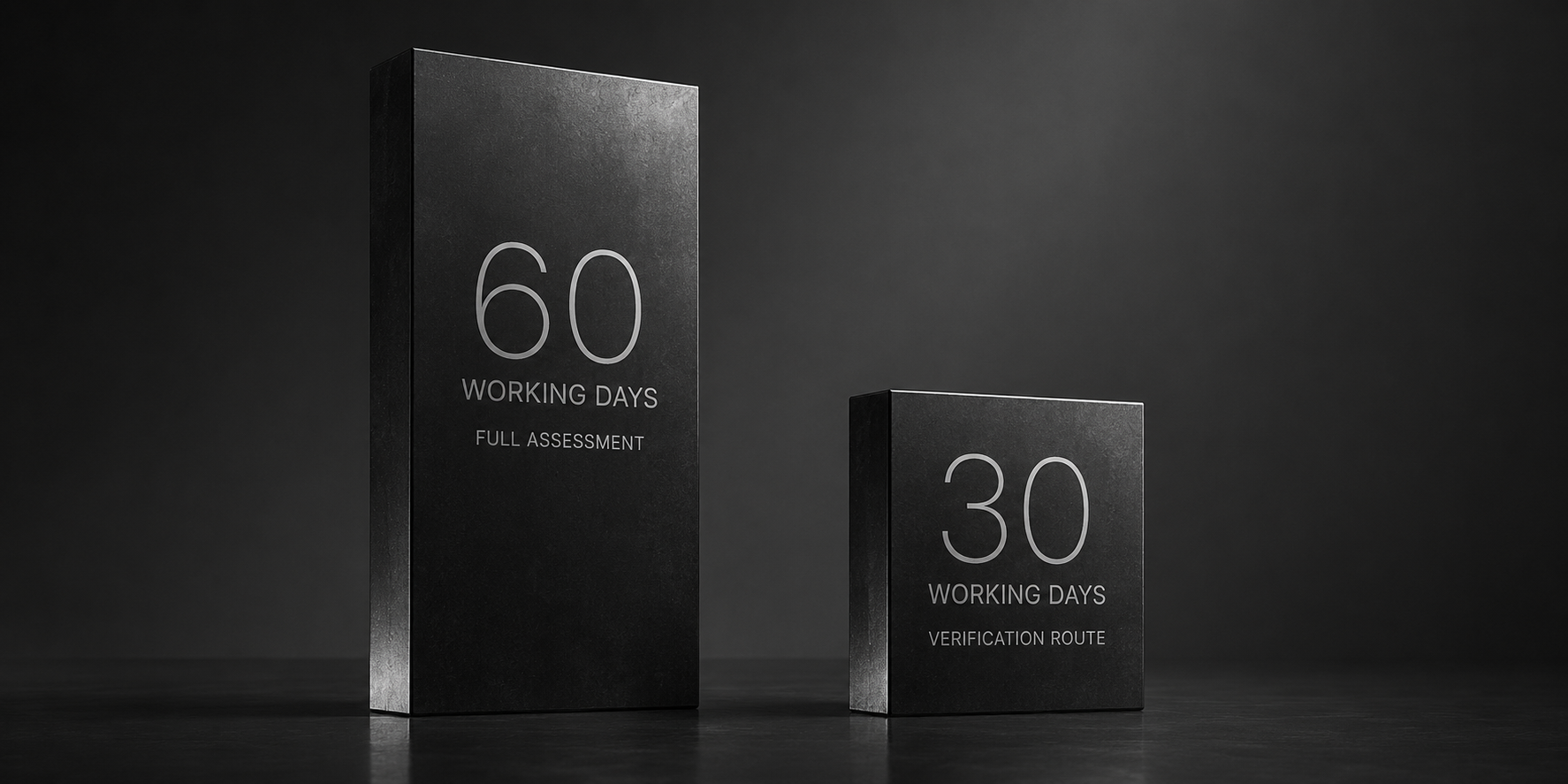
A medical device already registered in Singapore can now open Malaysia on a shorter clock. Since 1 March 2026, a Singapore Medical Device Register listing counts as an eligible basis for Malaysia’s Verification Route, cutting the conformity assessment step from about 60 to about 30 working days, with a further 30 working days for Medical Device Authority evaluation. One technical file carries most of the weight in both markets. The decision is no longer whether to file twice. It is which market leads, and who holds each registration.
This is new, and it is not permanent. The Health Sciences Authority and the Medical Device Authority moved their reliance programme from pilot to full implementation effective 1 March 2026, operating under guidance document MDA/GD/0070. Singapore joined Malaysia’s list of recognized authorities on 30 September 2025, and the old requirement for one year of marketing history before using the route is gone. For any manufacturer already holding a Singapore registration, Malaysia just became a much shorter step.
What actually changed on 1 March 2026?
Two regulators agreed to trust each other’s prior work. The Health Sciences Authority (HSA) is Singapore’s medical device regulator under the Health Products Act. The Medical Device Authority (MDA) is Malaysia’s equivalent under the Medical Device Act 2012 (Act 737). Both grade devices on the same four class risk scale, Class A lowest to Class D highest, and both require the ASEAN Common Submission Dossier Template (CSDT) as the technical file format.
The two signed a reliance memorandum on 22 August 2025 at the 14th ASEAN Medical Device Committee meeting in Siem Reap. A six month pilot ran from 1 September 2025 to 28 February 2026. From 1 March 2026 the programme moved to full implementation. Read that date carefully. Full implementation is the current operating basis, not a permanent treaty. It rests on MDA guidance documents that can be revised, so plan around the present text and watch the next revision.
The mechanism is recognition, not merger. Malaysia added HSA to its list of recognized authorities for the Verification Route, effective 30 September 2025, through the second editions of MDA/GD/0068 and MDA/GD/0070. A device registered on the Singapore Medical Device Register (SMDR) under a standard route now qualifies that device for Malaysia’s abridged conformity assessment. The reverse also holds: a full MDA registration earns an abridged review in Singapore, with up to 30 percent faster turnaround.
How much does the reliance route compress your Malaysia timeline?
The saving sits in the conformity assessment step. Malaysia registers Class B to D devices in two stages: a conformity assessment by an accredited Conformity Assessment Body (CAB), then evaluation and registration by MDA through the MeDC@St system. Under a full assessment the CAB review runs about 60 working days. Under the Verification Route, where a recognized approval already exists, it runs about 30. MDA evaluation after the CAB step is about 30 working days. For the full route, MDA evaluation is 14 to 20 working days for Class A and 30 working days for Class B, C and D on complete documents.
| Parameter | Malaysia full route | Malaysia Verification Route (HSA reliance) |
|---|---|---|
| Eligibility basis | No recognized approval held | Valid SMDR standard route registration |
| CAB conformity assessment | About 60 working days | About 30 working days |
| MDA evaluation | Class A 14 to 20 WD; Class B, C, D 30 WD | About 30 working days |
| Reference recognition | Not applicable | HSA recognized 30 Sep 2025; full implementation 1 Mar 2026 |
| Government fees, Class B | RM 250 plus RM 1,000, plus CAB fees | Same MDA fees, plus CAB fees |
| Key constraint | Full technical file review | Class must match Singapore; special access listings excluded |
Treat these as target timelines under current guidance, not guarantees. CAB capacity is the variable that can move them. Fees stay modest on the Malaysian side. A Class B registration carries an MDA application fee of RM 250 and a registration fee of RM 1,000, with CAB fees charged separately, set by each accredited CAB and varying by scope and device class. Singapore’s Class B abridged route is S$560 plus S$2,010. One recent change to note: Malaysian Class A fees rose from January 2026 to RM 500 application and RM 750 registration.
What does one registration actually require in each market?
One dossier does not mean one legal holder. Each market needs its own local entity, and that entity, not the manufacturer, holds the registration.
In Singapore the holder is the Registrant, a company incorporated in Singapore that holds the SMDR listing and carries a Dealer’s Licence as importer, wholesaler or manufacturer. Its quality system must be certified to ISO 13485, MDSAP or GDPMDS by a body accredited under the Singapore Accreditation Council. In Malaysia the holder is the Authorised Representative (AR), a locally incorporated company that holds an Establishment Licence under Act 737, submits through MeDC@St, and whose name and address must appear on the device label. The AR is the device equivalent of the Local Authorised Representative that Infinity Pharmacare holds for foreign principals.
The CSDT does the heavy lifting between them. A file built for one market reuses roughly 70 to 80 percent of its content in the other. What changes is predictable: labelling, the declaration of conformity format, local representative details, and proof of the reference registration. The point is not the paperwork overlap. Who holds the product registration in each market determines commercial control once the filing is done. A faster route delivers speed. It does not decide who owns the relationship once the registration is granted. Decide the holder before you decide the route.
Where does the two markets claim break down?
The route is conditional, and four conditions catch real devices.
Class alignment comes first. If HSA and MDA grade the same device differently, Class C in Singapore and Class D in Malaysia for example, the device falls out of the reliance programme and faces full assessment in Malaysia. Confirm classification in both systems before you plan around the route.
Special access listings are excluded. A device supplied in Singapore only under the Special Access Route, Emergency Use Authorization, Special Access Programme or Special Access Scheme does not carry a qualifying SMDR registration, so a full standard route listing is required first. Class D devices with a registrable drug in an ancillary role sit outside the arrangement as well.
Then the asymmetries. A UK MHRA approval is recognized by Malaysia for the Verification Route but is not an HSA reference agency, so it opens Malaysia without opening Singapore on the abridged route. And the 30 working day CAB figure is a target, not a statutory commitment. Only MDA accredited CABs can perform the assessment, and added demand from the wider programme can stretch the queue.
What this means for your ASEAN entry sequence
Sequence the filings around where your approvals already sit.
If you hold a Singapore registration or plan to lead there, file Singapore first, then run Malaysia off the SMDR listing through the Verification Route. If you hold a qualifying reference approval such as US FDA, EU, TGA, Health Canada or Japan MHLW, you can open both markets at once, since the core CSDT is shared and only the local forms, labelling and representative differ. For pharmaceutical products, the same reference approvals drive the NPRA facilitated registration pathway for an abridged drug review of 90 working days. If Malaysia is the lead market, the reverse path works: a full MDA registration earns the abridged review in Singapore at up to 30 percent faster turnaround.
For most internationally marketed devices, the parallel path is the strongest. It can land both registrations within a few months of each other and trims calendar time against filing in series. The programme rewards manufacturers who plan the two filings together rather than treating Malaysia as an afterthought once Singapore is done.
Key Takeaways
- Since 1 March 2026, a standard route SMDR registration qualifies a device for Malaysia’s Verification Route, cutting CAB conformity assessment from about 60 to about 30 working days, with about 30 more for MDA evaluation.
- This is full implementation under MDA/GD/0070, not a permanent arrangement. Plan around current guidance and watch for revision.
- The CSDT gives roughly 70 to 80 percent file reuse, but each market still needs its own holder: a Singapore Registrant and a Malaysian Authorised Representative.
- The route excludes mismatched classifications, special access listings, and Class D devices with an ancillary registrable drug. Confirm eligibility before you commit.
- Speed does not decide ownership. Whoever holds each registration controls market access. Decide the holder first.
This briefing is for general information only. It does not constitute legal, regulatory, or medical advice. Regulatory requirements change. Verify all details against current official guidance before making filing or commercial decisions.
Manufacturers weighing a Malaysia and ASEAN market entry can use this as the starting point for a sequenced market access plan with Infinity Pharmacare, including how the Authorised Representative and registration holder structure is set before the first filing.
Yes. Since 1 March 2026, a device registered on the Singapore Medical Device Register under a standard route qualifies for Malaysia’s MDA Verification Route, an abridged conformity assessment of about 30 working days.
About 30 working days for the CAB conformity assessment and about 30 working days for MDA evaluation, against about 60 working days for the CAB step under a full assessment.
No. It moved from pilot to full implementation effective 1 March 2026 under guidance document MDA/GD/0070, which can be revised.
A classification mismatch between HSA and MDA, registration in Singapore only under a special access route, and Class D devices with a registrable drug in an ancillary role.